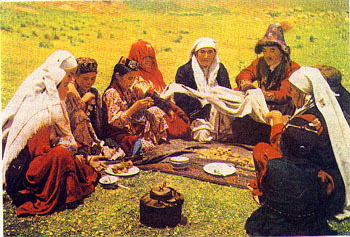
Population; 6.102.000 Ethnical Groups; Tajik people with the rate of 65%, Uzbeks with the rate of 25% Surface Area : 143.100 km2 Neighbours ; Uzbekistan, Kyrgyzstan, China, Afghanistan
Tajikistan has an important place in the borders of Afghanistan-Pakistan-China with the Ferghana Valley that is crucial point of the Central Asia.
Ferghana Valley that is confined between Uzbekistan and Kyrgyzstan that constitute the foundation of the region of Turkestan is considered as Çukurova of the Central Asia. The borders of Tajikistan divide the Ferghana Valley into three sections. Taking into consideration that the borders of Tajikistan has a structure that flames the ethnical elements, it can be observed that the tension in the capital city of Dyushambe is so dangerous for the Turkish-Islam world.
Like in the other republics, the tribal-separatist struggles that kept on in Tajikistan turned into a civil war within five years unfortunately. Hundred thousands of people took shelter in Afghanistan and Uzbekistan and therefore, new problems were added to the present social and economical problems. The conflicts that are called as the north-south disorder are under the influence of the foreign powers that try to establish dominion in the region. Therefore, it is the subject matter that these problems are on the verge of spreading to Ferghana Valley that was artificially shared among Uzbekistan- Kyrgyzstan and Tajikistan, to the entire country of Uzbekistan and therefore, to the entire region of the Central Asia.
The Afghanistani events constitute an element that prevents the economical development of the Central Asia that tries to export its natural gas and petroleum. Taking this situation into consideration, a second civil war that will burst out in Tajikistan will damage the independence of the Central Asian Republics and lead the Eastern Turkestan back to the national struggles of Uighur people. These developments in Afghanistan and Tajikistan are actually can be considered as an important issue not only for the Turkish-Islam world and Turkey, but also for the Western worlds and particularly the USA that tries to establish an equilibrium between Russia and China. The future of Uzbekistan that has undertaken the most significant task in the reinforcement of the Central Asia and naturally the future of its neighbouring countries are directly dependent on Tajikistan.
It is a reality that the difficulties that the Tajik intellectuals supporting the opposition forces in Uzbekistan suffered in the years of independence led to tension between two nations. The most despised people were the patriots that tried to express the realities in the period of Soviets. Similarly, it is possible to state today that those that try to illuminate the realities are despised in the same way. Unfortunately, there is not any environment of intellectuals that plans realistic investments oriented towards the future within Tajikistan and Uzbekistan that have laid foundation for the Turkestan civilisation. Similarly, the problems that can be resolved with short-term negotiations are not negotiated in an explicit manner. Therefore, the policy of the foreign powers that consider the region on a long-term basis is dominant in the region.
Within the government that frequently repeats the statement that Turkestan is our home, there are not any statesmen that perceive the Turkish-Islam ideal and adopt the democratic thoughts in the view of the Western world. Similarly, the relations of the neighbouring countries are damages that try to prevent the influence of Uzbekistan that is the natural leader of the region through the management of simple thoughts about Uzbekistan. This conflict can be clearly observed when the state presidents of the region gather in a meeting. There are actually different opinions among Tashkent-Ashkhabad- Almaty- Dyushambe and Bishkek in relation with the studies and works upon Aral inland sea that is considered as the natural disaster and the River Oxus and Syr-Darya River (Seyhun-Ceyhun) that are the water sources of the region. The subject matter of Euphrates-Tigris Rivers is of great importance for Middle East. In the same way, the subject matter of Rivers of Oxus and Syr-Darya has the same importance level for the Central Asia. The democratic state understanding that is felt to a certain degree in Kyrgyzstan is not present in Uzbekistan and Tajikistan and this lack augments the current problem of conflict.
Hocand (the province of Leninabad) that is the northern section of Tajikistan is considered as the centre of population of Uzbek people. The most developed places of the country in respect of agriculture and industry is the region that is identified as Hocand region inhabited by Hocand people that are the residuals of the people remaining from the former communist period. Therefore, this group in the south is opposite to Uzbekistan in the north as a near region. We can come across with Uzbek people in tyhe province of Kulab that is located in the Kurgan Tepe (Sepulture Hill) region, and particularly in the capital city of Dyushambe. Those that are near to the Afghanistani border are called as Kulab people. In the mountainous region of Bedahshan, there are Tajiks and Pamir people apart from some groups of Khirghiz people. Most of the Pamir people that consider themselves as different people from the Sunnite Tajiks and that even use a different dialect are identified as Ismaili supporters.
Since the country is divided into three sections with its high mountains, the relations between the regions are not so sound. The regionalism and tribalism is fairly powerful due to the economical problems. The government- opposition competition that started before the independence is within an extremely complicated state of affairs. Particularly, the drug and weapon traffic and smuggling that started to be observed in the Afghanistani borders and the desire of the Mafia groups to establish dominion in the sectors of crafts and trade have led to the deepening of the civil turmoil and conflicts. These groups that benefit from the civil war in Tajikistan purchase hashish and hemp plants from the mountainous regions. It has been known that these groups consigned these materials to Russia over Kyrgyzstan and Uzbekistan and even to the West over Turkey.
In the years when the government- opposition disputes did not end up with any results, the civil turmoil gradually concentrated upon the influence of Uzbekistan and Russia. These conflicts have posed a threat for not only Tajikistan, but also the other neighbouring countries. Hocand group that worked with the government for a specific period and the united allied forces that are dismissed from their offices due to the influence of particularly Tashkent- Moscow governments have won armed victories in the long-term periods. Therefore, these groups are on the verge of coalition with todays government in respect of the administration of Dyushambe. This situation is considered as a new beginning point both for Russia and Uzbekistan. The opposition including Uzbek- Tajik- Pamir people and the other communities would negatively effect Russia as it has been experienced in Tchetchenistan. Similarly, it will force the government of Kerimov that is against it to change its policy in Uzbekistan.
As a matter of fact, an assassination was organised against the President Rahmanov that represented the Southern people. As a result of this assassination, the local government condemns the group of the former Prime Minister, Abdullacanov that represented Hocand group and that was not offended from the negotiations of the government- opposition. Abdullacanov that was defeated by the president Nabiev in the former elections initiated some activities against the government for a specific period. There are some allegations that his activities are supported by the government of Tashkent. The government of Tajikistan considers these activities of the Northern people as the influence of Uzbekistan and they do not accede to accept the negotiations with Hocand group. The opposition that continued its activities for the government of national union disliked the group of Avdullacanov from Hocand that supported the ancient understandings of state. However, the opposition has declared its demand for the participation of this group in the further meetings. However, the unsuccessful event of assassination against the president did not provide any opportunity for this meeting. It is in question that the events that came into existence incessantly can possibly flame the North-South conflict.
Although we have identified the events experienced in Tajikistan after independence as regionalism in general, the economic conditions should also be taken into consideration. If the countries in the region do not want the domination of the foreign powers in the regions, particularly the neighbouring countries should understand that Tajikistan has an important place in respect of the peace in Central Asia. Especially it is due time for the guides of Uzbekistan to show much more tolerance in respect of this issue and to express that the possible change of government in Tajikistan will not effect Tashkent. In case that the state of Uzbekistan adopts the democratic developments within its borders and orientates towards political reforms, the tension in the region will get alleviated. Therefore, the groups that accept the union of Central Asia with a much comprehensive concept will actively work among the people and finally, the conflict of Uzbek-Tajik will be gradually eliminated around the thought of regional cooperation.