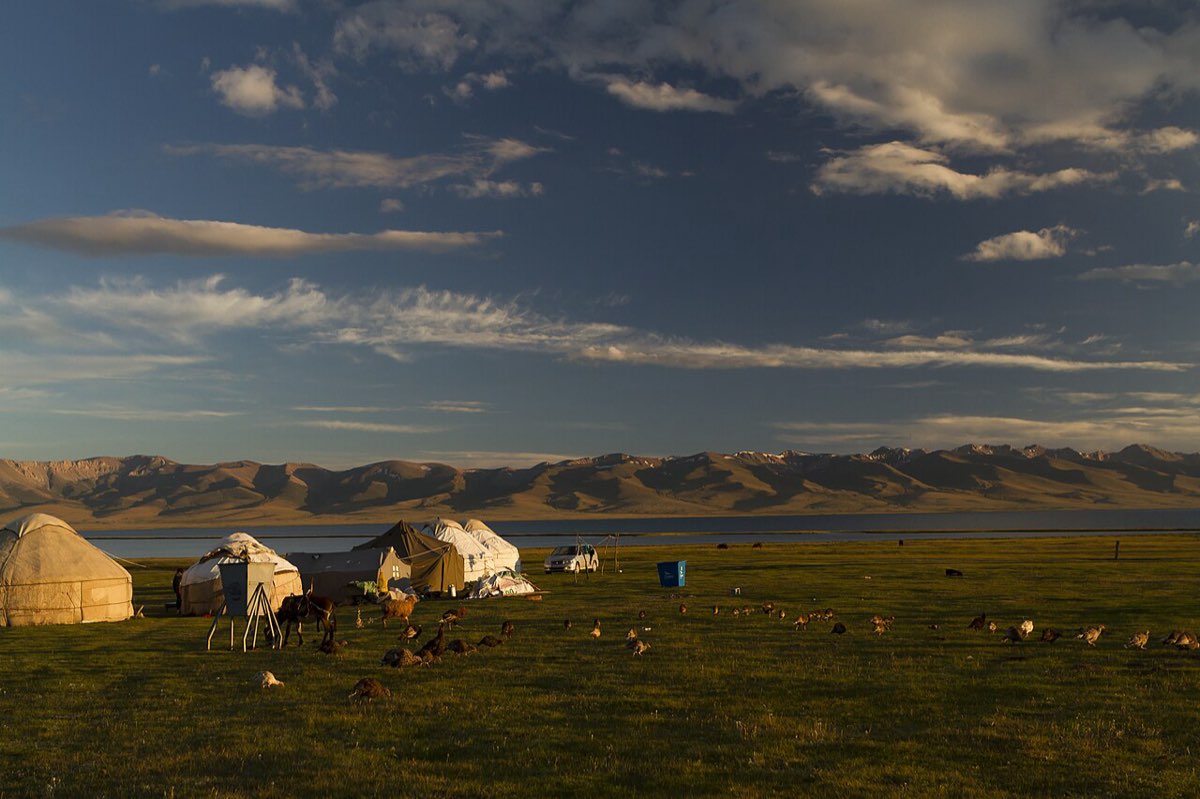
The Republic of Kyrgyzstan is surrounded with Kazakhstan in the north and northwest, Uzbekistan in the southwest, Tajikistan in the south, and Eastern Turkestan (PRC) in the east and southeast. Its surface area is 198.500 km2. Kyrgyzstan that declared its sovereignty on the date of 15th December 1990 and its independency on the date of 31st August 1991 is a Republic.
Kyrgyzstan that is located in the skirts of Tien Shan Mountains and Pamir Mountains has a mountainous surface structure. The average altitude is over 1500 meters. The range of Tien Shan and Pamir mountain chain specifies the geographical position of Kyrgyzstan. There are Kyrgyzstan Mountains and Çatkali Mountain that are the extended branches of Tien Shan Mountains and Atbaşi and Ferghana Mountains that extend towards the southwest. There is the Issik Lake with the most beautiful panorama of the world among these mountains and there is also the Ferghana Valley with the most fertile lands of the country.
A continental climate is dominant in Kyrgyzstan and a little rainfall is observed during the year in the country. The winters are warm and dry in the places that have the altitude of 2000 m above the sea level. The temperatures in the season of winter are fairly low particularly in the mountains and mountainous valleys.
The important rivers of Kyrgyzstan include the rivers of Narin, Tar, Kurşab, Talas, alay, Çu and Kızılsu. There are more than 3.000 lakes in Kyrgyzstan. The most important lake in the country is Issik Lake that is the second largest crater lake of the world.
The capital city of Kyrgyzstan is Bishkek and the population of the country is 4.472.000. Of this population, 39% of the people live in cities while 61% of the people live in rural areas. The density of population is observed as 20 persons per km2. The population is composed of Khirghiz people with the rate of 52.4%, Russians with the rate of 20.9%, Uzbek people with the rate of 12.7%, Ukranians with the rate of 2.4% and the other peoples with the rate of 11.6%.
Kyrgyzstan is divided into six administrative regions (Çuy, Issık-kul, Oş, Talas, Calalabad, Nevin) and significant cities of Kyrgyzstan include Bishkek, Oş, Calalabad, Tokmak and Karabalta.
In the period of the USSR, Kyrgyzstan was deliberately left in an underdeveloped level in the field of education and science. Pursuant to its independence, a rapid development is observed in the field of education. According to the data of 1990/91, there are 1806 schools with the level of secondary education and 9 institutions with the level of higher education. Furthermore, there are 16 universities and institutes, and 48 units of technical schools and schools of art.
7% of the lands of Kyrgyzstan is composed of arable fields. The fundamental agricultural products include the cereals, cotton, sugar beet, tobacco, potato, hemp, vegetables and fruits. The stockbreeding is highly developed and the breeding of sheep, goat and cattle, apiculture and breeding of pig have taken an important place in the recent years. Wool and leather are the most important sources of income.
The important natural resources are coal, gold, mercury and uranium. Kyrgyzstan has the control of nearly half of the coal reserves in the Central Asia. The petroleum and natural gas beds are located in the northeastern section of Ferghana Valley.
The fundamental industrial branches of the Republic of Kyrgyzstan are composed of textile, food, metallic and metallurgy industries, electronics, metals excluding iron, sugar, silken and cocoon fabric textile, leather processing, the agricultural and work machinery and tinned food production.
The working population in Kyrgyzstan is 1.835.900. Of this figure, 25.2% of people work in the sector of industry, 38.2% of people work in the field of agriculture, 19% of people work in the sectors of education and health, 6% of people work in the sector of services, and 11.3% of the people work in the sectors of transportation, communication and the other sectors.
By the year of 1994, the total exportation value was 340 million dollars and the total importation figure was 459 million dollars. There are BDT countries, China, USA, England, Germany, Turkey, France, the Netherlands and Japan among the countries with which Kyrgyzstan transacts foreign trade.
The Republic of Kyrgyzstan adopted its constitution upon the unanimous vote of the parliament on the date of 5th May 1993. The President was deprived of his position as the head of executive power and he was entitled as the coordinator of the state body.
The new Constitution stipulates a parliamentary system with 105 members similar to the Western countries and it is consisted of a legislative council composed of 35 members and a Representative Council composed of 70 members.