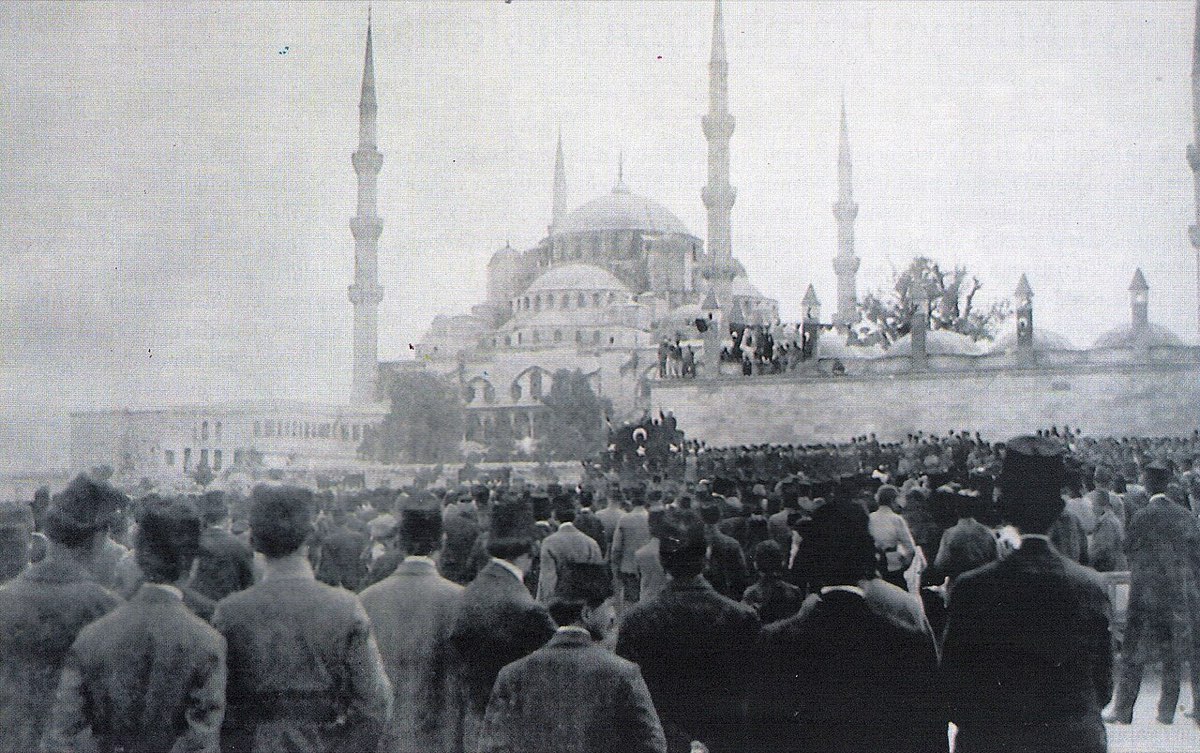
As it is known, the High Council composed of Lloyd George, Clémanceau and Wilson had given permission for the landing of Greek troops in Izmir on the date of 15th May 1919 on the pretext that there was a disorder in Anatolia and the Christian people were in jeopardy. Through the help of the passive resistance of the governor and the commander of the army crops, the Greek forces had invaded the city. The native Greeks had met the Greeks with flags in their hands. Chrisostomos who was the Great Orthodox Bishop of Izmir had sanctified the first forces that arrived in the city and one of the priests had started to cry out stating that Kill the Turks. Suleyman Fethi Bey who was the manager of recruiting office was bayonetted and killed and the Turkish officers suffered from the attack of thousands of native Greek people with stones and clubs. The skulls of some of thee officers were broken into pieces and some of the injured people were thrown to the sea before they died. The Greek groups with women and men that drank beer in the cafe bars had performed shooting training targeting the Turks that passed before them. The Turkish slaves with their hands tied were cut into parts and killed by the Greeks that were qualified as rabid by even the Colonel Mazarakis that was assigned by the Greek Prime Minister, Venizelos in order to investigate the events. It is beyond doubt that these murders that were committed in front of the civilised world increased twofold the sorrow and hatred of the Turkish nation. The government had resigned on the date of 16th May, and the authority to establish the new government was assigned again to Danat Ferit Pasha. Mustafa Kemal Pasha had forwarded a telegram from Samsun to the Grand Vizierate and he declared that the invasion of Izmir by Greeks could not be consented by the army and the nation. There were some meetings organised in Istanbul that condemned the invasion. An assembly was gathered with the consultative authorities under the name of Sultanate Council and representatives of the societies and the parties had participated in this council that gathered in Yıldız Palace. Enthusiastic meetings were organised all over the country and telegrams in protest were rushed to the official authorities in Istanbul.
The reactions against the invasion of Izmir were much more effective particularly in the Central and Eastern Black Sea coasts that were under the danger of such an invasion. A special board was sent to this region in order to express that this invasion did not mean the annexation of the city to the enemy. The people of Giresun had organised a big meeting of protest under the leadership of the Chief Mayor, Osman Aga (Topal Osman) on the date of 17th May. The regional press had also criticised the invasion with great reaction. Işık (Light) Newspaper was published with the addressing surrounded with black frames stating that Do not forget the Catastrophe of Izmir in Giresun. This newspaper had defined the effect of the invasion as follows: If lightnings would have struck from the skies, bloody volcano lavas would have gushed out of the mountains, and the seas would have overflown and flooded the region with deluges, they maybe would not have caused such an influence and effect among the Turks and the Islam world."
The same reactions to the invasion had been observed in the Eastern and Southeastern Anatolia. Among the meetings organised in various places of the Thrace, the most important meeting was Sultan Selim meeting organised in Edirne by the Ottoman Council of Defence of Thrace-European Turkey (Trakya-Paşaeli Müdafaa Heyet-i Osmaniyesi). All the people that became enthusiastic in Siirt rushed in large groups from the districts and sub-districts to the centres and organised meetings. 58.000 people had attended in the meeting that was organised on the date of 23rd June. On the date of 17th May, some telegrams were wired from Hasankale to the ruler and to the Grand Vizierate that condemned the invasion in the name of 30.000 people in Silvan. Besides these domestic reactions to the invasion of Izmir, there had been some reactions in the foreign countries. Some of the English competent authorities had considered this invasion as a rabid movement in respect of the consequences that it would lead. General H. Wilson who was the English Chief of the General Staff had considered this event as a terrible fault even before the invasion. There had not been any reaction observed in France, and only some authors such as Pierre Loti and Claude Farrere that knew Turkish people had criticised the invasion. The invasion of Izmir was considered with great anger in Italy. It is beyond doubt that they were not angry about the unfair invasion. Actually, Izmir had been determined as the share of Italy in the sharing projects that were planned even before the war. American people did not approve the violation of Wilson principles.
As a consequence, the invasion of Izmir had constituted one of the pages full of anguish in our history. However, it activated the national potential in respect of the National Resistance, and it led the enthusiasm of the nation to surmount its peak level. There was not any other way or means as much effective as this invasion to reveal the unpleasing real face of the enemy to the people no matter what is explained or told to the people. The invasion had coincided with the days in which Mustafa Kemal Pasha went to Samsun and undertook the responsibilities of the national resistance. This coincidence can be considered as the good fortune of our national resistance. The darkness that fell over the Western coasts of Anatolia on one hand a sun that rose from the northern coasts on the other hand. Probably this must have been the strange apparition of the history. The invasion of Izmir had been a faux pas that could not be estimated for its consequences in respect of the invader states and the beginning point of the Anatolian adventure of Greece that ended up with disappointment.
It is no difficult to express the pathetic and heart-rending situation of the empire in those days. This country that had suffered from three wars since the year of 1911 was defeated in all of them. American President Wilson had stipulated the principle of the establishment of an independent state for each nation in his famous article 14. However, Ottoman army was discharged despite this article. It was too difficult to find an officer in order to establish the union again. Furthermore, those who governed the state were not in favour of the resistance and struggle; on the contrary, they were in the pursuit of survival under the wing and mandate of any States of the Allies.
Against this collapse of the Ottoman Empire, there were some people who came into existence to find a solution for liberation in every region. Those who united among themselves established some organisations and they tried to announce their rightful voice through press and publications. There was a society established under the name of General Society of Defence of Rights in Thrace and European Turkey (Trakya Paşaeli Müdafaa-i Hukuk Heyet-i Umumiyesi) that tried to prevent the annexation of Izmir to Greece. The Society of Defence of Rights in the Eastern Anatolia (Doğu Anadolu Müdafaa-i Hukuk Cemiyeti) had started its activities in order to prevent the capture of the Eastern Anatolia by the Armenians. This society Followed a specific program in its activities. It had taken the resolution that the people would not emigrate from the region whatever may come. Therefore, they would not abandon their lands and let any other people to become the possessors of these lands. They should be organised in order to announce their rightful voice and to make propaganda. In case of any attack, they were determined to defend the eastern provinces as a whole union. The Ottoman Society of Defence of Rights in Izmir (İzmir Müdafaa-i Hukuk-ı Osmaniye Cemiyeti) was established in order to prevent the annexation of Izmir to Greece. This society turned into the Society for Rejection of Annexation (Redd-i İlhak Cemiyeti). Some societies had also performed activities in Istanbul and they tried to announce and declare their rights through various communication means.
It can not be neglected that these societies had been established and operated under very difficult conditions and they endeavoured to survive within this environment. However, they approached to the subject matter in respect of their views. There was not any institution within the Ottoman Empire that could establish the union. Since there was not a belief and determination to this effect in the government and the high-ranked offices of the state, it is possible to consider these attitudes of the societies as natural behaviours under those circumstances. Thrace and the Eastern Anatolia were involved in a struggle to save only their regions. If they could succeed, for example, A Thrace Republic could be established in the Thrace. Apart from these events, there was an opinion followed by some people about the English protection and mandate through the great efforts of especially the English Informers Society. The mandate of another state did not mean colonisation like in the past. According to these followers, an international organisation such as the League of Nations would supervise this mandate and protection and it would abrogate this mandate in the future periods. Furthermore, England had become very experienced in this field. In case that such a stance would be followed, the pressure of the other states would be prevented and we could guarantee our borders thereof. Some of the environments in Istanbul most of which had good intentions considered the American mandate (management) as much more positive event instead of the English mandate. United States of America was in favour of freedoms. The President Wilson had emphasised this issue with the article 14. Furthermore, it would not be easy to repulse the English people once they had settled in a region. The problem was to stimulate the American senate to this effect
As it can be observed, the ways of liberation were different from one another. According to some people, the regions should be saved. Moreover, some people advocated for the English protection while some others preferred the American mandate.
Mustafa Kemal Pasha did not consider any of these ways as appropriate. According to him, it was a reality that the Ottoman Empire had collapsed and its lifeline had come to an end. However, he could be involved in a struggle to save and prevent the disintegration of Anatolia with the Turkish inhabitants on it. There was no other way than the establishment of an independent Turkish state based on national sovereignty. What if the struggle to be undertaken would fail? We would be under the domination and management of foreign states. If so, we would accept this result in advance and abstain from the acquisition of our independence through involvement in a struggle of resistance. However, he had a principle that he always had kept in his mind and heart that was oriented towards either independence or death. He should continue his efforts towards the leadership of this nation and the accomplishment of this movement for liberation.
Tevfik Pasha Government was changed in the month of February in 1919, and Damat Ferit Pasha became the Grand Vizier. The new grand vizier could only think about getting on well with the English people and winning their favour and thus, coaxing soma privileges from them. Therefore, various people were arrested and exiled to Malta. All the patriots that were in Istanbul waited for their destiny with anxiety.
Mustafa Kemal had some negotiations with his close friends in the house that he had rented and he arranged some plans for the future. He should go to Anatolia and organise the people of Anatolia. Meanwhile, he met with his school friend, Ali Fuat Pasha who had come from Adana and obtained information about the situation of Anatolia. Ali Fuat Pasha had introduced Mustafa Kemal with Mehmet Ali Bey who was a member of the government of Damat Ferit Pasha. This introduction would be of great benefit for the future. Furthermore, Kazim Karabekir Pasha who was in Thrace had met with Mustafa Kemal Pasha in Istanbul before he departed to the east in order to take over the Commandership of the 15th Army Crops. Therefore, the proper supports had been attained with these two old chaps. The problem was to pass to Anatolia henceforth.
Georges Milne, the English commander who had been in Samsun sent a report to the High Commission in Istanbul in those days and stated within the report that there was disorder in and within the environs of Samsun. The high superintendent office sent this report immediately to the Grand Vizier Damat Ferit Pasha. This board declared that there were some attacks to the Greek people in this region and the public order could not be established in this region. They had also notified that the invader forces would lay hands on the issue unless the proper precautions would be taken.
Damat Ferit Pasha got flurried about this situation that annoyed the English people and he tried to find a solution. He called Mehmet Ali Bey who was the Deputy Minister of Foreign Affairs and he asked him what to do under these circumstances. Mehmet Ali Bey had met with Mustafa Kemal Pasha before and he knew that Mustafa Kemal wanted to pass to Anatolia. He told the grand vizier that it was not possible to find a solution to the matter from Istanbul and it would be appropriate to send a competent authority to the region. He also added that the most appropriate person for the accomplishment of this duty was Mustafa Kemal Pasha.
Damat Ferit Pasha invited Mustafa Kemal for dinner in order to get acquainted with him. After the meeting, he found it appropriate to assign Mustafa Kemal for this position. Mustafa Kemal who met with the Minister of War, Şakir Pasha and he wanted from him that his appointment would be made on official basis. He wanted that his duties would not be limited with reporting the disorders and conflicts between the Turks and Greek people in this region. He wanted more extensive powers and authorities. He was occupied with this issue in person. He went to the Directorate of General Staff and he arranged the order for appointment. In respect of the extensive authorities, he also had provided the great support of Kazim Pasha from Diyarbakir who was his friend and also the Second Chief Commander of the General Staff. Apparently, Mustafa Kemal was the superintendent of the third army. However, he had so extensive authorities and powers that he could be considered as the General Superintendent of Anatolia. However, it was obligatory that this order should be signed by the members of the cabinet. Mehmet Ali Bey took over this work. He brought the order of appointment while Damat Ferit Pasha was playing bridge in Circle dOrient Club and the Grand Vizier signed this order without even looking at it. The order of appointment that was signed by the grand vizier was also signed by the other ministers. This order was approved by the ruler on the date of 30th April 1919.
While Mustafa Kemal Pasha was occupied his plans for the passage to Anatolia and the organisation of the movement of liberation, there were negative incidents that were ongoing in Paris against Turkey. Lloyd George had provided some privileges to the Greek people and he lit the green light for the Greek forces to land in Izmir. Italians resisted against the invasion of Izmir by the Greek people even for the sake of their desires. However, the Italians had to withdraw from the High Council due to Fiume Incident. Therefore, Greece could do whatever it wanted in the absence of Italy. Wilson did not show any resistance. Clemenceau was indifferent in the subject. Therefore, the great states had given permission to Greece to land troops in Izmir in the month of May.
Mustafa Kemal Pasha was invited for dinner to the house of the Grand Vizier, Damat Ferit Pasha in the evening of 14th May 1919. After the dinner that passed in a cold atmosphere, the Grand Vizier reviewed a map that was brought to the hall and asked Mustafa Kemal Pasha: What will you do in and within the environs of Samsun? Mustafa Kemal told that there were disorders in the region according to the English reports and he was convinced that the events were exaggerated. He also said that the problem could be resolved with a research that he would carry out in place. Cevat Pasha who attended the dinner with him supported Mustafa Kemal and told that these sorts of problems could only be resolved in place. The main anxiety of the Grand Vizier was the place that would be under the domination of Mustafa Kemal and he did not want him to have broad and extensive powers in the region. Upon this issue, Cevat Pasha interfered and he calmed down the Grand Vizier stating that there was hardly any forces left in Anatolia. While they were departing from the mansion in Nisantaşi in that night, Damat Ferit ordered Mustafa Kemal to visit the ruler before he departed.
On the following day, the Greek forces composed of twenty thousands of soldiers had landed in Izmir. When this news was heard in the Sublime Port of Government, Mustafa Kemal was there in order to bid farewell to the Ministers of War and Internal Affairs. There was a rush and flurry in the surrounding. Mustafa Kemal wandered what they would do in this case. The Ottoman competent authorities stated that they would only protest this invasion. In other worlds, they would repulse the Greek forces through protesting and the English forces would make the Greek forces retreat from the region! When Mustafa Kemal asked whether the ship that would carry him to Samsun was ready for the voyage, it was stated that Bandirma ship waited for him in the quay. Then, an order was arranged for the captain in reference with the departure. Before setting off, Mustafa Kemal would have a last visit and go to Yıldız Palace bid farewell to the ruler. This would be the last meeting of the last Ottoman ruler and the founder and the first president of Republic of Turkey.
Mustafa Kemal and Vahdettin sat side by side so close that their knees touched one another in a small hall of Yıldız Palace. There was a table to which the ruler had leaned his elbow on in the right of the ruler and a book on that table. The ships of the enemies could be seen from the windows and these ships were positioned like they had turned their artillery guns towards Yıldız Palace. Vahdettin said: Pasha, Pasha! You have had much service for the state up to now. All of your services must have been included in this book and in the history. Forget them, the service that you will provide from now on may be more important than they are. Pasha, you can save the country. In the beginning, Mustafa Kemal Pasha could not understand clearly what the ruler meant with these words. Does Vahdettin support his struggle for liberation of the nation through passage to Anatolia? However, he did not get excited and he did not say any words about this issue. He was contented with expressing his gratitude. Against this stance of him, the ruler had to explain his thoughts more clearly. He told that the Ottoman State did not have any forces and they were obliged to act in compliance with the policies of the Allied States in Istanbul and the obey the directives that they ordered. Mustafa Kemal told him not to worry and said that he would try as best as he can. Then, he left the ruler. When he got out of the hall, Naci Pasha who was the adjutant of the ruler presented a watch embroidered with the first initials of Vahdettin on it to Mustafa Kemal as a gift of the ruler.