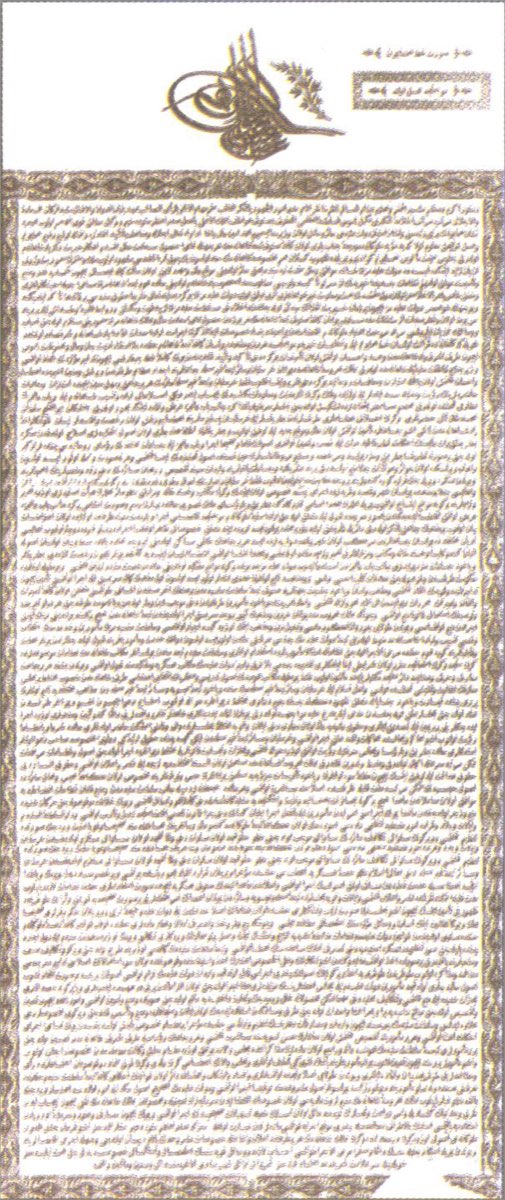
It is totally wrong to commence the history of the innovations in Turkey with the Period of Reforms (1839). It will be much more appropriate to date back the movement of innovations with the event of Vaka-i Hayriyye (1826) that took place 13 years before the Period of Reformsç Actually, the radical reforms were carried out by Mahmut II between the years of 1826-1839. The Period of Reforms was a consequence of the aforesaid reforms and actually, it was planned by Mahmut II. Upon his death, these reforms were put into practice and accomplished by his fellow, Reşit Pasha. In the period between the years of 1826-1839, the entire order that was in progress for centuries in the significant institutions was changed. In this period, Mahmut II experienced great foreign difficulties and troubles at the same time. Moreover, the Turks were in one of the most critical periods that they were subject to in the course of their history. In order to initiate the Greek revolution again, English, French and Russian allied navies attacked to the Turkish naval fleets in the port of Navarin and then, they incinerated the Turkish navy (20th October 1827). Russia officially declared war against the Ottoman State and It surpassed Prut and penetrated into the Turkish lands (8th May 1828). The navy of Mahmut II had been incinerated. Since he had abolished the societies of the Janissary Guards, he did not have any army at all. In order to train his new army in accordance with the European procedures, he stayed in the barracks in Rami for the season of the winter. He supervised the training of the new troops like an ordinary colonel within clays. He also participated in the military training practices. The Russian War that continued less than one and a half year was finalised with Edirne Agreement (15th September 1829). Turkey did not have any friends. Besides, England and France imposed pressure on the state. For example; France sent an army to Mora in order to support the Greek renegades. Edirne Agreement had stipulated heavy conditions and Turkish Empire suffered from great losses and sacrifice: The entire coastal region of the Eastern Black Sea that extended from Kuban River in the Caucasus towards Batum (excluding Batum) was abandoned to Russia. Therefore, Russia had established dominion in the eastern coasts of the Black Sea pursuant to its domination in the northern coasts.
Turkey only had the southern and western coasts of the Black Sea. Actually, Turkey could only maintain the southern and western coasts. The Sublime Ottoman Government acknowledged that Georgia was under the possession of Russia and it renounced from all its rights related with this country. The states of autonomies pertaining to Eflak (Southern Romania), Bogdan (Moldavia) and Serbian princedoms were extended with new privileges and they were nearly surrendered as a surety to Russia. Turkey paid an exorbitant amount of war reparations (11,500,000 golds). The state withdrew from the regions such as Romania, Bulgaria, Edirne, Kars, Erzurum, etc. and it gave it back. The economy of Turkey was undermined with this heavy amount of war reparations. Therefore, the Tsar Nikolay I that was a fanatical enemy of Turks deprived Sultan Mahmud that he envied of the facilities and economic opportunities that the Sultan needed in order to accomplish his several reform projects.
The foundation of the state of Greece was approved in accordance with this agreement. On the date of 24th April 1830, Mahmut II had to recognise the independence of the Greece that he had rejected as much as he could. This state of Greece that was founded was the first independent state in the Balkans. This state came into existence as a poor kingdom with the surface area of (49,424 km2) that was one third of todays Greece and with the population of 1,000,000 people. Commencing as of the stage of its foundation, it started its policy to take shelter in Russia, England and France that had led to the foundation of this state. Therefore, it would provoke them on a continuous basis and try to expand its borders. In the beginning, the Great States tried to establish a state of Greece including Mora and Cyclades Islands that was subject to Turkey like Srbija. However, after a period, they forced the Sublime Ottoman Government to surrender the Attica Peninsula and the Euboea Island to this state and to recognise the independence of the new state.
Sultan Mahmut established a much-centralised administration. He was the merciless enemy of the influential families and persons and the other feudal lords that had attained influence and prestige in the provinces, districts, and anywhere. He acted in a merciless manner about their rights. Actually, these people were abusing the state for a long time and they did not obey to the central government. He also arranged his modern army and navy. He also founded the first modern and big schools, particularly War Academy and the Medical School hat provided education in French language and that could evaluate and examine the Western civilisation profoundly. He also undertook large-scaled public works. He modified the palace and government organisation radically; he abolished all the traditions and organised these institutions in European style. He accomplished all these beneficial works within the environment of great oppositions. The people called him as the Non-Muslim ruler.
France considered the weakness of Turkey and invaded the city of Algiers (5th July 1830) and within a few years, France exiled all the Ottomans from the Algeria. In his last years, Mahmut II encountered the rebellion of Egypt Governor, Kavalali Mehmet Ali Pasha unfortunately. This was the biggest rebellion that the Ottoman Empire has suffered in the course of its history. The rebellion took place between the years of 1831-1833. It passed through a balance period and its second stage began in the year of 1839. The army of the Egypt Governor that was entirely composed of the Turks advanced towards Kutahya (2nd February 1833). The Ottoman troops were defeated. Finally, the Ottoman army was defeated in Nizip within only 2 hours (24th June 1839). This terrible disaster was kept confidential from the great ruler that was on his deathbed who would died after 7 days.
Mahmud II was the greatest ruler among the rulers that had followed Kanuni 1566) and he was the founder of modern Turkey. He had reigned the state for 31 years, and he died at the age of 54 due to his grief and sorrow resulting from mostly the Russian troubles. All the Ottoman dynasty members that replaced him had followed him in the pursuit of his works.
On the verge of the Period of Reforms, Turkey experienced one of the most critical moments of his history the year of 1839. The period of 13 years that passed between the event of Vaka-i Hayriyye and the Tanzimat-ı Hayriyye (Beneficial Reorganisation) (1826-1839) had changed the structure of Turkey Empire a lot. There was not any significant difference in form between the institutions in the period of Fatih and the institutions that Mahmut II had inherited. However, the highest and the greatest institutions of the state that were highly developed in the past had become degenerated; and they were on the verge of collapse in the period of Mahmut II. Mahmut II equipped the state with contemporary institutions. He abolished and annulled the old army and he established the modern army and navy. He established close relations with the Western civilisation. Through the adaptation of several elements from this civilisation, he explicitly declared that the West was superior to Turkey for the first time in the history. Turkey had an inheritance of a very glorious history. However, this inheritance constituted a burden and even an obstacle in front of the development of the state.
Mahmut II established dominion over all the disobedient governors excluding Mehmet Ali and most of the feudal lords that were called as ayan (headmen) and they were under the control of the central government or he annihilated some of them. He reestablished the authority of the state over the provinces that had gradually become ineffective between the years of 1789-1826. In the period of his death, the problem of Mehmet Ali had gained an importance that would pose a threat for the future of the empire. However, the genius of Mustafa Reşit Pasha would eradicate this threat. Actually, the Period of Reforms can be considered as the work of Mahmut II. However, the execution of the new regime would be dependent on the stance and attitudes of the persons that would establish dominion in the state administration in the future in the place of Mahmut II. The geographical position of Turkey did not resemble to Japan. The state was surrounded by ferocious and rakish imperialists and the cruel enemies. It gradually became much more difficult to defend the extensive empire in respect of military affairs and diplomacy. While the state was occupied with arrangements for new movements, the continuous foreign interventions and attacks prevented these movements and advance. In the year of 1839, it was not a dream to reinvigorate the former prestige and dignity of Turkey and to catch up with the West despite the distance between them. This work would become a dream towards the end of the century XIX.
The rulers that followed Mahmut were his 2 sons: Abdülmecit I (1839-1861) and Abdülaziz Han (1861-1867). These rulers were the rulers of the Period of Reforms. Abdülmecit I who was at the age of 16 had a character of the first modern ruler. He spoke in French language. He gave permission to Reşit Pasha about the declaration of the Reforms (2nd November 1839). From that date on, it was not possible to perform the acts of executions, arrests, exiles, tax collection and the conscriptions unless a court decision was obtained or these acts were based on laws. This was the first step taken in the path of democracy. It was not an ordinary step for the year of 1839. It was not a casual and ordinary step both for the East and for the West.
Reşit Pasha resolved the problem of Egypt in the capacity as the Minister of Foreign Affairs (1840-1841). He repulsed Mehmet Ali Pasha from all the Ottoman provinces that he had invaded through dazzling and intricate diplomatic combinations. Henceforth, the governorship of Egypt and Syria would be maintained by Mehmet Ali and his family. However, each of these countries would still be the provinces of the Ottoman Empire. On the date of 28th September 1848, Reşit Pasha was appointed as the grand vizier for the first time and the Reformist team against the traditionalist conservatives started to establish dominion in the state administration. Reşit Pasha trained a team of statesmen some of whom had an incredible genius (Âlî Pasha, Fuat Pasha, Cevdet Pasha, Vefik Pasha, Safvet Pasha, Mehmed Pasha, etc.). He protected the empire with a diplomatic genius that can be considered as the greatest prime minister in the history of Turkey. He increased his foreign prestige to a significant degree. While the Revolutions in 1848 destroyed Europe, Turkey recovered this period with glory and honour. On the verge of the second half of the century XIX, the situations of the Great States were as follows:
The world population that was estimated to have been 955 millions in the year of 1825 increased to 1137 millions in the year of 1850. While the Big States had a total population of 654 millions in the year of 1825, this number has increased to 902 millions in the year of 1850. It again reduced to 235 millions in the year of 1925. The era of imperialism was started; and England captured significant parts of the world and it established the 3rd biggest empire of the history following the Rome and Ottoman Empires.
The situations of the Great States were as follows. Within the quarter century (1825-1850), the population increases pertaining to the states took place as follows: the increase from 119 millions to 259 millions in England, the increase from 32 millions to 39 millions in France, the increase from 48 millions to 68 millions in Russia, the increase from 58 millions to 54 millions in Turkey, the increase from 320 millions to 380 millions in China, the increase from 30 millions to 39 millions in Austria, the increase from 11 millions to 17 millions in Prussia, the increase from 5 millions to 23 millions in United America, and the increase from 19 millions to 23 millions in Spain. In the year of 1850, there were 3,2 millions of slaves in United America and there were millions of serfs (slaves bound to the land) that lived in Russia. The slavery was abolished in Turkey. In the beginning of the century XIX, the population of a city, namely London passed the population of Istanbul for the first time in history and there was an urbanisation based on industry. In the year of 1825I there had been 227 cities with the population over 50,000 of people. However, in the year of 1850, this figure increased to 291 and the number of the cities with a population over 100.000 people increased from the number of 106 to the number of 115.
In the year of 1850, the approximate population of the big cities within the Ottoman Empire is as follows: İstanbul with the population of 1,400,000, Cairo with the population of 355,000, Damascus with the population of 215,000, Edirne with the population of 200,000, Baghdad with the population of 160,000, and Aleppo with the population of 150,000. There were also 8 cities with the population between 100-150 thousands and 22 cities with the population between 50-100 thousands. The number of the cities that had a population over 50.000 was 40 in Turkey, 63 in England (including the colonies), 17 in France, 15 in Russia, 12 in Austria, 10 in Iran, 10 in Japan, 11 in Spain, 6 in United America, 33 in China, 7 in Prussia, and 5 in the Netherlands. London was the biggest city (2,237,000). The populations have increased to 1,398,000 in Paris, 991,000 in New York, 569,000 in Manchester, 1,000,000 in Peking, 1,000,000 in Canton, 800,000 in Tiecin, 432,000 in Petersburg (Leningrad), 412,000 in Berlin, 409,000 in Philadelphia, 408,000 in Naples, and 400,000 in Vienna.
Reşit Pasha was convinced that Turkey would not have a peace unless it struck Russia with a great movement. It was not possible for Turkey to accomplish such kind of a strike all alone in the year of 1850 any longer. Although the Turkish land forces followed France and Russia and the Turkish navy followed England and France in respect of power, a war with an attack against russia was beyond the power of the Turkish Empire from that date on. However, the state was confident in itself in only a defensive war. Resit Pasha provoked Russia in a proper manner that this state could lately understood such provocation. The diplomatical environment was arranged. The war with Russia broke out actually on the date of (3rd July) and legally on the date of (4th October 1853). This was the famous Crimean War. Omer Pasha defeated the Russians for several times in Romania. The Russians that wanted to capture Silistre were totally destroyed in a crushing manner (25th June 1854). While the war progressed in favour of the Turks, Resit Pasha concluded and signed Alliance Pacts with England, France and even Sardinia that tried to establish the Italian union and these states joined the war on the side of Turkey against Russia. The Allied forces landed troops in the Crimea (14th September 1854). Upon the capture of the most fortified city of Sivastopol (9th September 1855), Russia that had suffered great casualties and losses gave in. the conclusion of Paris Agreement gave an end to the war (30th March 1856). An extremely heavy condition was stipulated against Russia stating that Russia could not have any war vessels and shipyards in the Black Sea. Turkey took a short break with this stipulation. Meanwhile, Ali Pasha declared the Sultans Mandate of Improvements in 1272 (18th February 1856) and through this mandate, all sorts of rights were entitled to the Non-Muslim citizens and subjects although these rights were not executed in practice. It was observed that the Christians were assigned to the high-rank offices of the state, the governorship of the provinces, embassies, viziership and even to the ranks of prime ministry for the first time in the Ottoman history.
Pursuant to the death of Reşit Pasha (7th January 1858), the leaders of the Period of Reforms were Âlî Pasha and his assistant, Keçecizade Mehmet Fuat Pasha. Like their masters, these two persons followed the policy for the survival of the empire and the reinforcement of the internal structure of the state through their diplomatical genius and intelligence. Sultan Abdulaziz had visited the province of Egypt (April 1863). Pursuant to this event, they took him to a foreign journey to Europe. This was the first and the last foreign journey of a ruler in the history. This journey was very glorious and successful (21st June 7th August 1867). The Suez Channel was opened (19th November 1869). Meanwhile, Fuat Paşa died (12th February 1869). As a result of the war between Prussia France, the empire collapsed in France and the Kingdom of Prussia accomplished to establish the German union and it declared the foundation of the German Empire. Therefore, these events radically changed the balance in the world. Germany came into existence as the 2nd state of the world following England and it had the most powerful land forces of the world. Russia that benefited from this situation declared that it would have war vessels and shipyards in the Black Sea and it violated the Paris Agreement. Turkey had to accept these circumstances with London Agreement (13th March 1871). Meanwhile, the death of Ali Pasha (7th September 1871) prevented the execution of the principles of the Reforms. The Reforms were not put into practice as they were stated in the documents. The inefficient statesmen followed each other within an instable environment. Actually, Sultan Abdulaziz was inclined to an authoritarian government. Therefore, a civil turmoil burst out in the Turkish Empire.