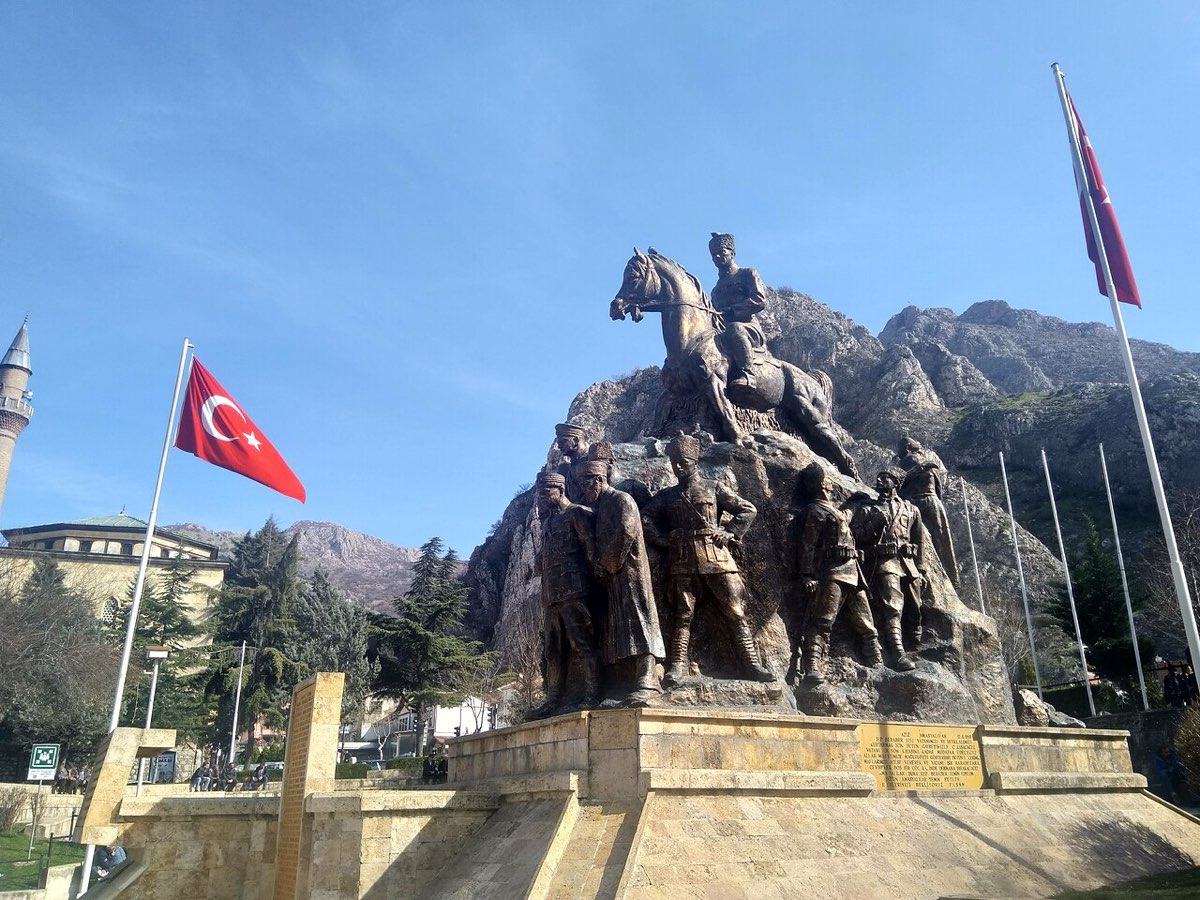
Mustafa Kemal Pasha was determined to assemble a general congress in Sivas in order to unite the Anatolian and Roumelian organisations and societies. To this effect, he dictated a circular to his adjutant, Cevat Abbas in the night that connected the date of 21st June to the date of 22nd June. It can be stated that the Amasya Proclamation is the beginning point of our national movement of liberation and our war of independence that was waged by great Ataturk. The significant issues of this circular were as follows:
The integrity of the country and the independence of the nation are in jeopardy. Since Istanbul Government is under the influence and domination of the Allied States, it could not perform the obligations that it has undertaken. The determination and resolution of the nation would save the independence of the country. It is required that a national council shall be established without any influence and domination in order to announce the rightful voice of the nation. It has been resolved that a national congress shall be assembled in Sivas that is the safest and the most secure place of Anatolia from each direction. To this effect, it is required that three delegates that have acquired the confidence of the people shall be sent from each district of all the cities as soon as possible. Taking into consideration all sorts of possible negative incidents, this issue shall be kept confidential as a national secret and the delegates shall continue their journeys in a confidential manner.
A congress shall be assembled in Erzurum in the name of the Eastern provinces on the date of 10th July. In case that the representatives of the other provinces can reach to Sivas until the aforesaid date, the members of Erzurum Congress shall set off in order to participate in the general congress to be organised in Sivas.
In respect of the election of the delegates by the National Societies of Defence of Rights and the Directorates of Municipalities or in any other ways, I request the support and aid of your patriotism. I also request that the names of the delegates that are elected and the departure dates and times shall be notified in advance.
I request the immediate acknowledgment of the receipt of this telegram.
This circular with the meaning of an invitation to the Sivas Congress was sent to the military and civil authorities in an encrypted manner. Furthermore, Mustafa Kemal Pasha sent this circular with letters to the significant persons such as Ahmed Izzet Pasha, Halide Edip, Kara Vasif, Ahmet Riza, etc. In this letter, he stated that it was not possible to accomplish the liberation through only the organisation of the meetings; and that it was required to directly depend on the power of the nation; and that Istanbul should be subject to Anatolia henceforth and that there were very important duties and obligations for any person in this respect.
Amasya Circular was signed by Mustafa Kemal Pasha, Ali Fuat Pasha (Cebesoy), Rauf Bey (Orbay), Refet Bey (Bele) and the participants in the headquarters committee of Mustafa Kemal Pasha. Furthermore, the approvals of Kazim Karabekir and Cemal (Mersinli) Pashas had also been received through telegraph. Amasya Circular has the quality of a program that includes the motives, grounds and the methods of the movement of national liberation. First of all, the dangers and the threats that the country and the nation encountered were revealed and afterwards, the resolutions for the liberation were expressed in this circular. It can be stated that the statement indicating that the integrity of the country was in jeopardy was a message for those who considered the regional liberation as a resolution of the problems. Pursuant to the emphasis on the weakness of Istanbul Government, it was stipulated that a national council should be established instead of this government. This situation indicates the characteristic of the circular as a declaration of revolution. The statement indicating that the determination and the resolution of the nation would save the independence of the nation nearly constitutes the core of the circular. With this statement, the opinions of national independence and the national sovereignty have been emphasised and the elements of nation and nationalism were considered as saviour elements that substituted the ruler, the caliph, and the mandate and domination of the powerful states. Since Amasya Circular stipulated for the assembly of a national congress, it has been considered as the first important step in the establishment of the union and cooperation of the nation.
Mustafa Kemal Pasha had sent letters to some persons in Istanbul together with the circular and he also had mentioned about the following considerations in brief: He had pointed out that only the meetings and the demonstrations could not ever save the great targets and ideals; and that these could be considered as saviour elements only if they depended on the common power that actually arose from the nation. He stated that the most influential effects that threatened the miserable situation were the opponent movements in Istanbul and political propaganda against the nation that left the national case in the lurch detrimental to the movement. He also indicated that Istanbul was not dominant in Anatolia and it had to be subject to Anatolia henceforth. In the course of his activities in Amasya, Mustafa Kemal Pasha had received the enormous support of Abdurrahman Kamil Effendi that would be the Mufti of Amasya in the further periods. He had given a speech addressing to the people. He stated in his speech that: the honour, self-respect, freedom, and independence of the nation are actually in jeopardy. If we require to get rid of this calamity, we should risk dying until only one person of the country is left behind. Let alone the ruler and the caliph, any person or authority under any name or title does not have any power or existence in the country. The only solution for liberation is the direct sovereignty of the nation to save and rescue of the self-determination of the nation. These words of him had activated the people of Amasya.
The publication of Amasya Circular did not delay in attracting the reactions of the invader forces in Istanbul. Especially they increased the pressures that they imposed over Istanbul Government in order to call back Mustafa Kemal Pasha to Istanbul. Upon this event, Istanbul Government dismissed Mustafa Kemal Pasha from his post on the grounds that he did not return despite his call-back on the date of 23rd June and he provoked the people against the government. Then, Istanbul Government resolved that the Ministry of Internal Affairs should notify this situation to the corresponding provinces.
Since Mustafa Kemal Pasha had heard of the news about some activities against him in Sivas, he arranged a troop of the Division V in order to advance in this direction as a precaution. Mustafa Kemal Pasha departed from Amasya on the date of 26th June. He passed through Tokat and he arrived in Sivas on the date of 27th June. He was welcomed and greeted with lovely demonstrations of the people and army that showed affection to him. He met with Elazig Governor, Ali Galip who had provoked Sivas Governor, Reşit Pasha against him in order to arrest him and he reprimanded him for this action. However, Ali Galip was able to conceal his actual purpose with his hypocritical replies that he presented to Mustafa Kemal Pasha. While he was in Sivas, Mustafa Kemal Pasha heard of the news about the circular of Ali Kemal Bey, Minister of Internal Affairs in reference with his dismissal and the order for the non-performance of his directives henceforth. Nevertheless, he wired a telegram to Erzincan Head Governorship Office and stated that he was assigned to this post upon the order of the ruler; and that he had not received any notification from the relevant War Ministry in reference with his dismissal; and therefore that the civil officials were obliged to perform his directives.
Mustafa Kemal Pasha provided the proper instructions for the organisation and actions in Sivas. Then, he set off for his journey to Erzurum on the date of 28th June. He received a telegram wired in the name of the ruler in Erzincan on the date of 2nd July. In this telegram, it was ordered to him to return to Istanbul, and if not possible, to take a furlough from War Ministry for a period of a few months and to rest in any place until the conclusion of the peace treaty. Furthermore, Mustafa Kemal Pasha received a second telegram from War Ministry that repeated the same demands. In his replies that he wired, Mustafa Kemal Pasha told that he would not leave his military office and he would continue his work. However, the same types of telegrams from both the palace and the War Ministry kept on rushing even after his arrival in Erzurum on the date of 3rd July. He had received a telegram of the War Ministry that called him back in the name of the ruler on the date of 5th July. On the following day, he wired a reply telegram stating that he would not return. Mustafa Kemal Pasha received a telegram wired in the name of the ruler on the date of 8th July. In this first telegram, it was stated that his resignation and return to Istanbul was not recommended against the possibility of any dishonourable act of the foreign states that imposed pressure on the government. However, he received as second telegram on the same date. This second telegram stated that English competent authorities had provided guarantee for his return and that there was not any reason of hesitation left in respect of his return to Istanbul. However, all these last efforts of Istanbul in order to call back Mustafa Kemal Pasha did not yield any result. Upon this failure, the rulers decree was issued on the same date in reference with his dismissal from his post. Nevertheless, Mustafa Kemal Pasha who had advocated the principle of legitimacy in all periods of his life wired telegrams to both the War Ministry and the ruler in the night of 8th-9th July. In these telegrams, he declared that he had resigned from his official post and also the military profession. On the date of 9th July, he declared a circular addressing to the army, provinces and the nation. In this circular, he declared that he would endeavour all his efforts for the national case as an individual of the nation from that date on.