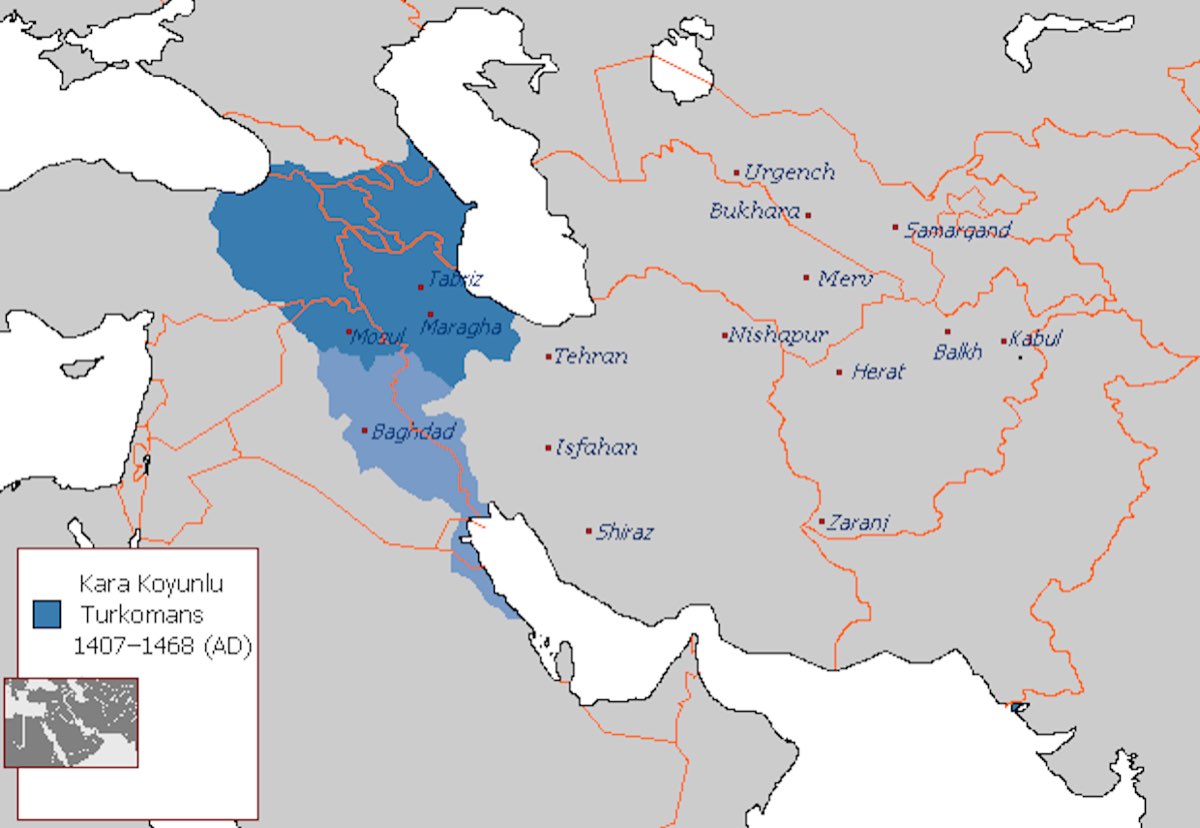
However, dynasty of Karakoyunlu is put forward to be called Barumlu, it is still not known where the name origanally came from and from which Oghuz Tribe they belonged to. As it is stated above, the estimation that Karakoyunlular had their origins in Yıva is the most suitable speculation. We already stated in the political history that Karakoyunlu State, getting a strong admonistration, had put many tribe into their management. We couldn't come across the documents dated 16.century and proving the existence of Karakoyunlular in Musul and in Kerkuk. After the region having linked to the Ottoman Empire; a few recording, concerning Karakoyunlu Tribe, was found in the deed inventery belonging to the region. Some of the districts settled by a great number of group were called Ra's al-Turmen.The other parts were living al-Kadıya, Siveha, and some villages of Musul. Karakoyunlu Tribe forming 35 houses, 7 bachelors in H.932 had 1302 Silver coins. In H.1946 (M.1539) Karakoyunlu Tribe composed of 66 individuals. In the period of III.Murad; Doğan Kethüda Community, 66 individuals, Ulaş Kethüda 35 individuals, and Allahverdi Kethüda 47 individuals were exempted from 400 silver coins. In the deed inventery dated H.965 (M.1558), we find out that there were three groups belonging to Karakoyunlu Tribe. In there, Doğan Kethüda seems to be the first Karakoyunlu group.The group consisting of 28 bennaks (the houses obliged to pay farm tax) and 24 mücerreds (the bachelors obliged to pay farm tax) were stated to be obliged to pay 3982 silver coins for tax.
Another group confirming at the same date conisisted of 36 bennaks and 8 mücerreds. Among the Kethüdas of group paying totaly 4230 silver coins, interesting ones were Bayram, Budak , Hüdakulu, Oruç, Şahkulu, and Şahverdi. The other groups, who were Karakoyunlu, were obliged to pay 738 silver coins as having 9 bennaks and 5 mücerrets.Some of them were: Allahkulu, Durmus,Gundogmus, Huseyinkulu, Ildogmus, and Sahverdi.
the period of Karakoyunlu, the facts that Musul andKerküt were leading a dense Turkicizing period and this tribe left traces in these areas up to now were clearly understood. Many Karakoyunlu, who passed to settled life abondening the tribe life, were decreasing in numbers among the Turkmen Tribes with whom they were living in small and large places. In spite of this, today the villages in which the tribe belonged to Karakoyunlu were settling are known. From those whom were eminent in Musul are these: Yukarı Karakoyunlu, Asağı Karakoyunlu, Cemaliye, Resıdiye, Kadıye (Kadıköy), Ba'vize, Diric, Cinci, Barıma, Fazıliye, Ortaharap, Telyara, and Omer Kayacı.
Yukarı and Asağı Karakoyunlu villages, which have kept their name of tribe up to now combinated and became a village. Locating in 20 km northwest of Musul, Karakoyunlu village was set up on a tumulus land. As found out from historical remanats around its surroundinds, it is understood to have been an old settlement. The Turkmen people living in Tazehurmata, 20 km south of Kerkuk, believe that their origin came from Karakoyunlu and after Mogol (Tatar) Invasion, their villages were revitalized by Karakoyunlu.
The Turkmen people of Bostanlı, one of the tribe belonigng to Bayat and living in Tuzhurmatu in Kerkuk, stated that their origin came from Karakoyunlu and the tribe migrated from some parts of Azerbaijan and Turkey. Agroup in Bastamlı called Karakoyunlu is known to be maintaining its existence until now.