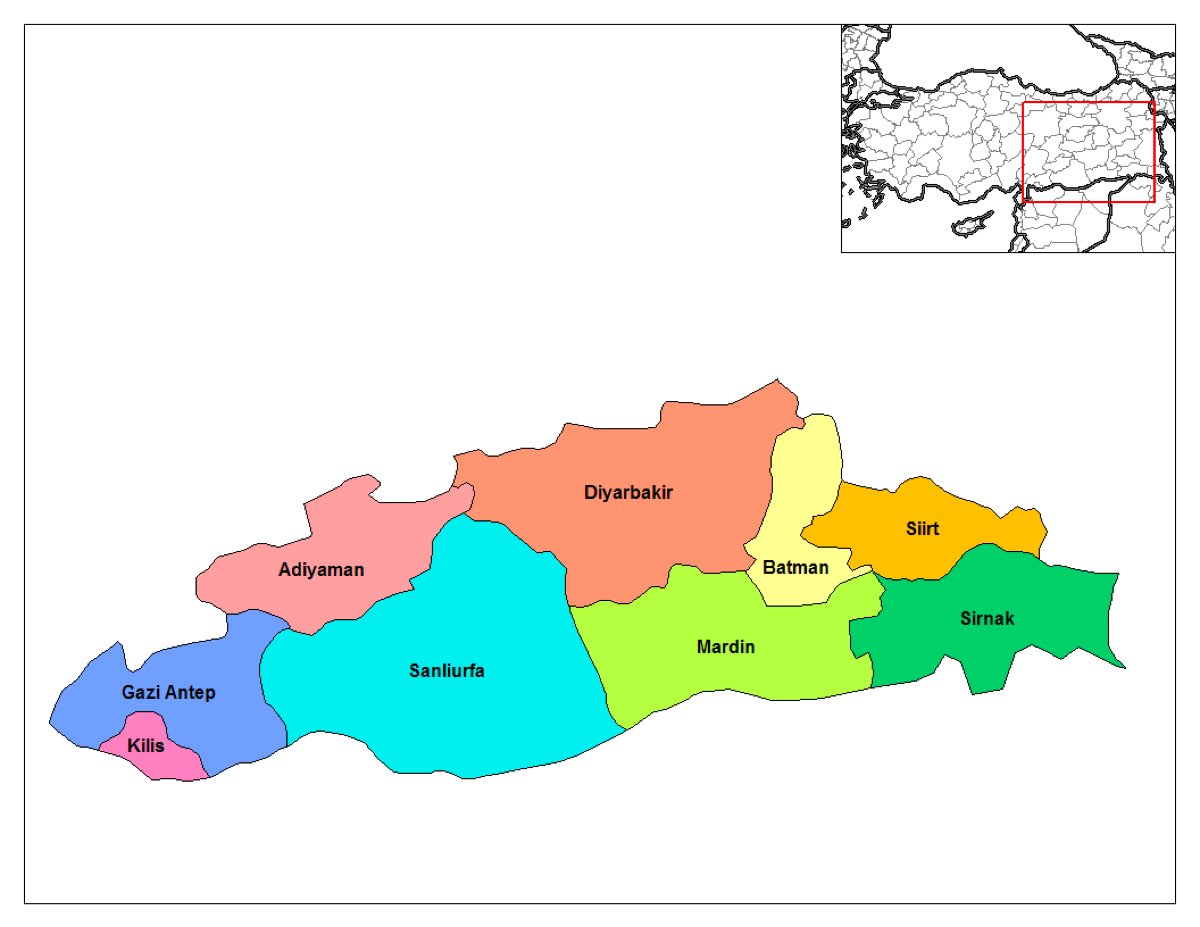
With its surface area of approximately 75.000 km2, the Southeastern Anatolian Region covers 9.7% of the total areas of Turkey. It is neighbouring the Eastern Anatolian and Mediterranean Regions. Furthermore, it has borders with Syria and Iraq. Like in the other geographical regions, the borders of the region do not match the borders of the provinces. Excluding some little sections, the provinces of Şanliurfa and Mardin are entirely located within the boundaries of this region. Some sections of the other provinces are located within the Eastern Anatolian and Mediterranean Regions. The continental climate conditions and the Mediterranean climate conditions are dominant in the Southeastern Anatolian Region. The summers that are long lasting are very hot and arid. The winters are cold and rainy. In the recent years, there have been some dam lakes founded in the region within the scope of the Southeastern Anatolian Project (GAP). Due to these developments, there have been some changes in the climate of the region. There has been a decrease in the rate of aridity in summers and the rainfalls have increased.
In respect of agricultural economy, the Southeastern Anatolian Region resembles much to the Central Anatolian Region. Due to the similarity to the Mediterranean climate, there are a variety of the vegetable products in the region of Gaziantep. Excluding this area, most of the arable fields have been divided to the cultivation of cereal grains. Wheat takes the first place among the cereal grains and its share ratio in the total production of Turkey exceeds one-tenth of total figure. Barley takes the second place and lentil takes the third place among the other cereals. More than 50% of the total lentil production in Turkey pertains to the Southeastern Anatolian Region. The cultivation of rice is maintained particularly in the province of Diyarbakir and in the other sections with the facility of irrigation in a disorganised manner. Within the scope of GAP project that has changed the destiny of the region, aquiculture has been implemented in some plains and the plantations of cash crops and truck farming have been accelerated. As a matter of fact, a great explosion of development has been observed in the plains of the region and particularly in Harran Savanna that extends from the south of Şanliurfa towards the border of Syria in respect of cotton production. The cotton of the highest quality is produced in this section of the region. Tobacco that as important place among the cash crops is cultivated in the section of Adiyaman, Siirt and Diyarbakir and a valuable tobacco type that is called as Eastern Type is cultivated in these provinces. Pistachio is produced in the sections of Adiyaman and Siirt. Particularly the pistachio with big nuts that is cultivated in Diirt is extremely delicious.
The most important underground resource of the region is petroleum. Some of the crude oil that is produced within the environs of Raman, Garzan and Kahta is refined in Batman Refinery that is one of the most important industrial plants in the region. Some of this oil is conveyed to the filling stations in the Mediterranean regions and then consigned to the other regions with tankers.
In respect of industry, Gaziantep is the most important city of the Southeastern Anatolian Region. Textile, machinery and food industries are highly developed in this city. The industrial branches that have considerable place in Diyarbakir, Mardin and Şanliurfa where the industry is in progress of development are cement, food industry, metallic materials and agriculture machines, etc.