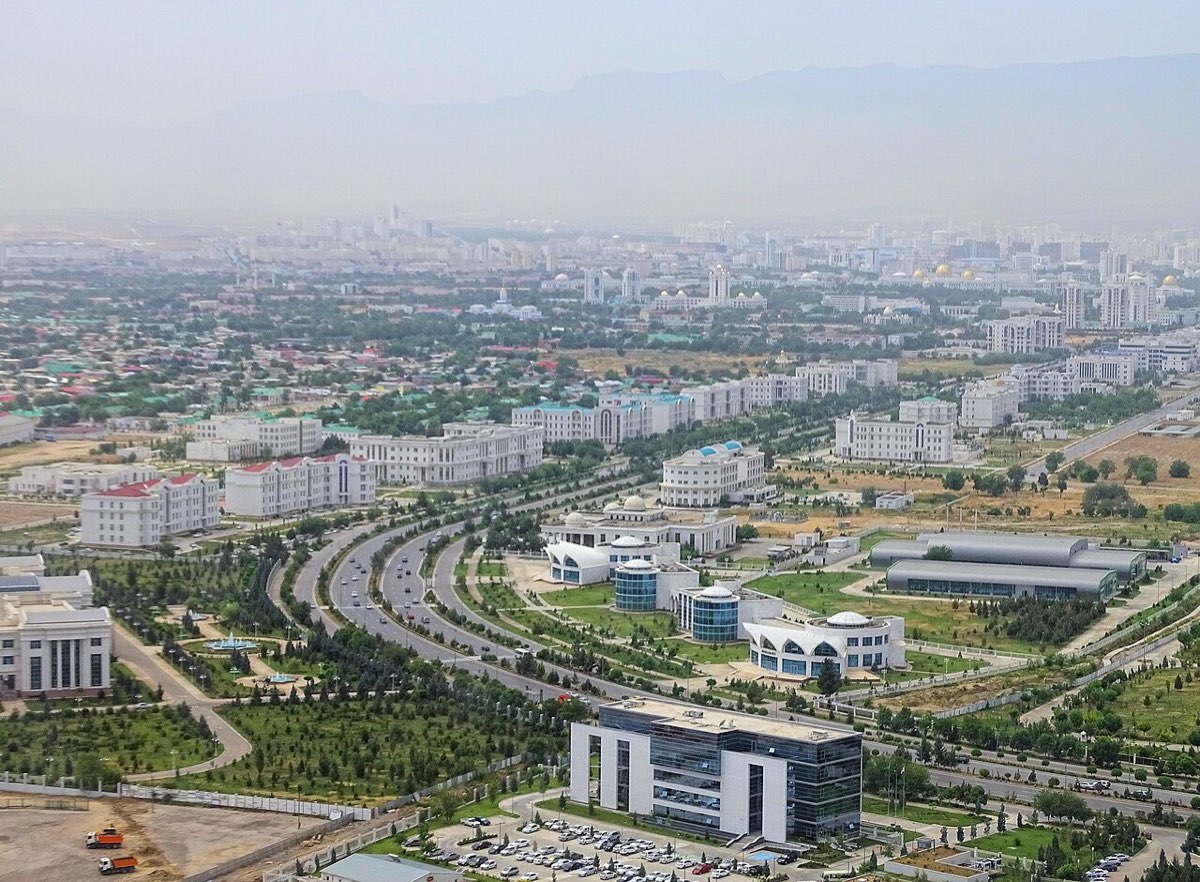
Ashkhabad that is the capital city of the Republic of Turkmenistan is located in the south of Karakum Desert that is in the east of the Caspian Sea and in the northern skirts of Kopetdağ Mountain range that extend between Turkmenistan and Iran. Ashkhabad is located in the interior side with the distance of 30 km from the border. Ashkhabad was the most important nomad tribe (avul) with five hundred tents in the region of oases that was called as Ahal Teke since the people were composed of Teke Turkmens until the end of the 19th century. However, pursuant to the invasion of the region by the Russians in the year of 1881, the region was turned into a city. Firstly, Russians built a castle in this region and they turned this city into the capital city of Zakaspiskaya province that they newly founded.
After four years, the railway tracks that would connect Krasnovodsk in the coast of the Caspian Sea to Bokhara and Tashkent were railed through this city. Therefore, Ashkhabad became the focus of the migrations of Russian immigrants in large groups. It turned into an important centre of trade and light industry within a short period. The Bolshevik government that was founded in the year of 1917 was overthrown by the counterrevolutionists that were composed of the Belorussians and Turkmen people. However, after a short period, the Red Army troops under the command of General Kuybiçev recaptured the city. Therefore, the name of Ashkhabad was changed as Poltoratsk that was the name of the revolutionist who had been influential in the formation of the first Bolshevik government.
In the course of the structuralism of the Soviets in the year of 1924, the city was declared as the capital city of Turkmen Soviet Socialist Republic that was newly established and its name was returned to Ashkhabad again in the year of 1927. Ashkhabad that was totally destroyed in the great earthquake that took place in the year of 1948 was reconstructed in a much wider area according to the same plan but with the buildings of fewer altitudes.
Pursuant to the disintegration of the Soviets Union in the year of 1991, the Republic of Turkmenistan declared its independency. The capital city of this republic is a trade, industrial, cultural and artistic city today. There are various factories and workshops manufacturing glass, engines, bodywork, agricultural devices, cotton and silken textile, thread, shoe-making and food industry in Ashkhabad. There are also 6 higher education institutions including particularly Maxim Gorki Turkmen University, the Turkmen Academy of Sciences, Desert Institute and the Southern Turkmenistan Archaeological Institute in Ashkhabad.
The most important cultural and artistic institutions include the Archaeology Museum where the ancient works that had been extracted in the excavations within the region are kept, the Ethnography Museum including the works that had a magnificent value in respect of Turkmen ethnography, a research library where Farsi handwritten manuscripts are protected, various theatres and film studios that turn the city into a movie industry.
The population was 351 thousands in the year of 1984. This population was composed of Turkmen people with the rate of 30 percent, Russians with the rate of 50 percent, and the rest of the population was composed of the other ethnical groups. However, pursuant to the declaration of independence by Turkmenistan in the year of 1991, the rate of the Turkmen population in Ashkhabad started to increase with a great speed.
Cotton, cereals, vegetables, grapes, melon, watermelons, etc. are cultivated in the oasis lands of Ashkhabad that are watered with Karakum Channel that was completed in the year of 1962. The stockbreeding is still maintained in the region. The most important animal product is the fur of karakul lamb (astrakhan fur). The most important minerals in the region are zinc, lead, sulphide, and barytes.
Nesa, one of the cities of antiquity that is located in the west of Ashkhabad with the distance of 7 kilometres is in ruins nowadays. Anov Sepulture (tumulus) is located in the east of this city with the distance of 10 kilometres where the ruins pertaining to one of the most ancient centres of population in Asia were excavated. Anov Sepulture was composed of two hills that extend in the direction of north-south. In this sepulture, the traces of a civilisation that was composed of 4 cultural layers were determined as a result of the archaeological excavations that was carried out in the beginning of the 20th century. Anov has a great significance in respect of both the history of Central Asia and therefore, he history of Western China. The first culture of Anov pertains to the civilisation of neolithic (Neolithic Age) era when the people lived in the houses made of sub-dried bricks and knew the agriculture, domestication of the animals and manufacture of earthenware pots. The last culture in this sepulture pertains to the civilisation of a prehistorical metallic period that knew the iron.
The recent studies carried out in the field of chronology have shown that the third culture pertains to the end of the 6th millennium BC or the beginning of the 5th millennium BC. This situation is of great significance since it displays that there were some civilisations in the Central Asia as much ancient as the civilisations in the Asia Minor. There is a mosque located near the Anov Sepulture. It was understood from the epitaph of this mosque that Ebul Kasim Babur (died in 1457) had constructed it. This mosque collapsed in the earthquake of 1948.