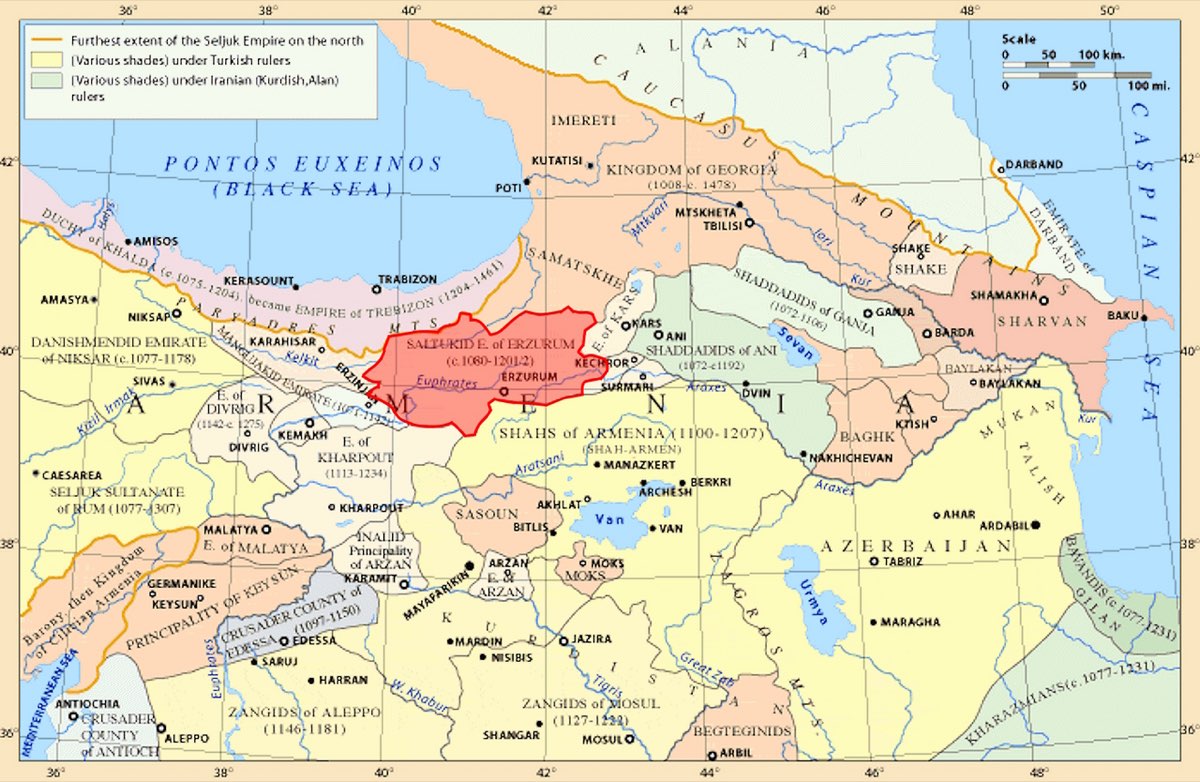
Principality had been one of the Turkish states established in the Eastern Anatolia in the course of the Seljuk conquests. Ebul Kasim who had been commissioned in the conquest of Anatolia had captured the environs of Erzurum and Sultan Alp Arslan had appointed him to the bey principality of this region. When Ebul Kasim had died in 1102, his son, Ali replaced him and became Bey. Izzeddin Saltuk who had become Bey pursuant to Ali was the most powerful of this dynasty and the bey principality had been called with his name, in other words, as Saltuk Bey Principality (1072).
In the beginning, this bey principality had been submissive to the Great Seljuk State, but upon the decline of this state, they acquired their independency. Saltuklu Bey principality captured Kars, Bayburt, Oltu, Trebizond, Ispir, and Tercan regions and strengthened their power. They firstly fought with the Georgians and then the Byzantine and had acquired great successes in these wars. They had established an alliance with Seljuk Sultan Kilic Arslan II and the relationship had been established through marriages.
The Saltuklu Beys had fought against the Georgians several times. In one of these wars, Izzeddin Saltuk had been taken as prisoner by the Georgians (1153), and he had been saved through the payment of 10.000 dinars by the other Turkish beys.
When Izzeddin Saltuk had died in 1174, his son, Muhammed Kizil Arslan replaced him. Kizil Arslan Bey defeated the Georgian forces that had come in front of Erzurum in 1195.
In the period of Izzeddin Saltuk (1132-1168), the country of Saltuklu Bey principality had extended from Tercan towards the Tahir Gediği region; and it included the cities and towns such as Erzurum, Bayburd, Avnîk, Micingird, Ispir, Oltu, etc. It has been observed that Nâsıreddîn Muhammed (1168-1191) had been submissive to the Iraq Seljuk Sultan, Tugrul III and the Tutor Kizil Arslan who actually had the power of domination.
In his period, the Georgians had come in front of Erzurum again, but they were contented with the spoils that they had acquired and they returned to their country without any involvement in a war or blockade. One of the events that attracted attention in this period was the marriage of the Saltuk Bey from this dynasty who was named as Muzaffereddîn Melikşâh with the Georgian queen, Thamara.
Since the middle of the century XII, the Turkey Seljuk State and the Eyyubi State started to threaten the bey principalities in the Eastern and Southeastern Anatolia. Meanwhile, Melikshah who had become the Great Khan wanted to subdue all the bey principalities in order to establish a union in Anatolia. Suleymanshah followed his policy and captured the castle of Erzurum in 1202 and abolished the Saltuklu Bey Principality (1202).
In the period of Saltuklu bey principality, the region of Erzurum had improved and had become more prosperous. Furthermore, they had invigorated the economical situation of the region. There are some works that have survived since the period of Saltuklu bey principality. These are Kale Mescidi (small mosque), Tebsi Minare (minaret), Ulu Câmi (Mosque) and some other mausoleums. Moreover, Mama Hâtûn caravan and mausoleum located in Tercan are among the significant Saltuklu works.