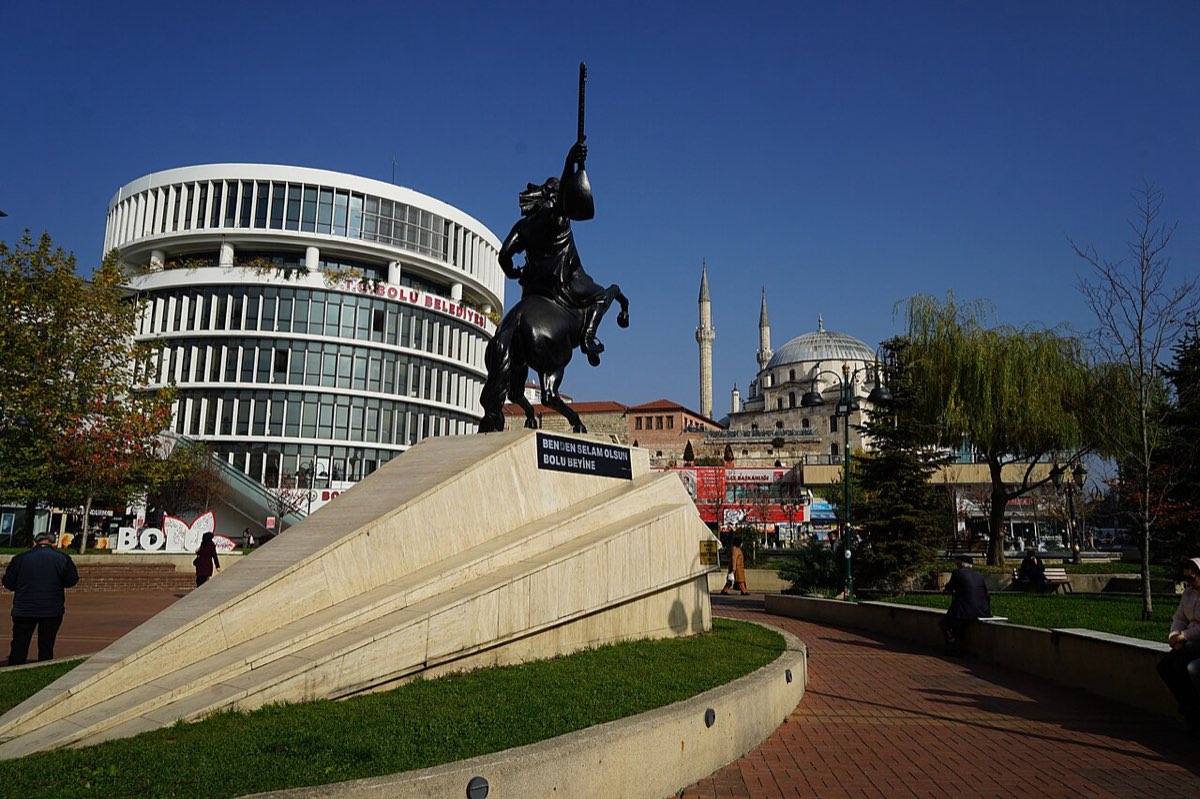
He is a public hero who is the subject of a famous epic. There is a troubadour bearing the same name who lived in 16th century too. But real Koroglu, whose historical personality is not known, lived near Bolu in 17th century, his reputation getting widespread in Anatolia later on. He was named as Koroglu (Son of Blind) since his father was blinded by Bolu Emir. His rebelling against persecution and protecting people's right make him an epic hero.
17th century is a period when non-central organizations revealed in Ottoman empire when emirs, governors linked to the palace and grand vizier could sometimes oppressed the people.
In such a period, Suleyman Bey, the emir of Bolu, got very angry with one of his grooms who served him for years and ordered that he be blinded. Bolu Emir was a very rough, oppressive man. Even his lovers mediated, he persisted. Poor groom who did not fulfil the order on time was blinded and extracted from the castle on a skinny horse. The injured groom bent down and whispered to the horse who knew his voice very well:
- The world is a prison for me from now on, take me to my village...
So they went, and at last, arrived at the village of the groom. His fifteen year-old son, seeing his father coming being fell on the back of a horse, understood his grief like a seventy-year old saint, ran and made him dismount from the horse, and brought him to his mother. The groom told about the events one by one saying "this is what has happened" and willed that his son take revenge, passing away there.
Koroglu mounted on a horse when he was fifteen. The gray horse of his father came to life, fattened, became an active animal. Koroglu took to the hills on his horse. He wore sword. He took an oath that he would take revenge of his father. He had with him the saz of a shepherd he met on the way. He stopped anybody he came across, and playing his saz, told about Bolu Emir's oppression.
He knew that he would certainly come across that oppressive person he was looking for everywhere. In time, his animal began to run like wind. Villagers called Koroglu whenever there was some corruption. So he went and provided order.
One day he stayed at Çamlıbel. He saw that a caravan chief robbed a young man, one of his passengers, and threw to the cliff. He beheaded the caravan chief with one single strike of sword. Other people prayed for him. The young passenger he took out of the cliff said: "You saved my life, from now on, I am your slave". Koroglu, learning that his name was Ayvaz and the caravan was carrying goods to Bolu Emir, took him with himself. They departed together.
Koroglu and Ayvaz went to find the oppressive Bolu Emir who terrorized everywhere and collected tributes from the poor villagers. There was a castle near the city. They heard a sad song from the crenels of the castle early in the morning. A young girl sang that she was Bolu Emir's daughter and that his father put her into prison just to prevent her from loving anyone in tears. Koroglu took the saz, and said to her that she should be patient and that he would save her.
When they arrived in Bolu, people had gathered in a big arena. Public celebrations were held. Koroglu took part among the wrestlers changing his clothes. He defeated every one of them one by one. At last, Bolu Emir called him and said:
-You wrestler, who are you? I appointed you as the chief of my guards.
Koroglu said: "I am the son of the groom you blinded" and blew a strike with his sword, beheading him in front of the public, and saved the people from a tyrant.
Then he sent Ayvaz and took Emir's daughter. He married her. After that, he treated with justice to people as the emir of Bolu.
His poems became notorious for centuries:
Bizden selâm olsun Bolu Beyi'ne
Çıkıp şu dağlara yaslanmalıdır
Ok gıcırtısından, kalkan sesinden
Dağlar sada verip seslenmelidir
Düşman geldi tabur tabur dizildi
Alnımıza kara yazı yazıldı
Tüfek icat oldu mertlik bozuldu
Eğri kılıç kında paslanmalıdır.