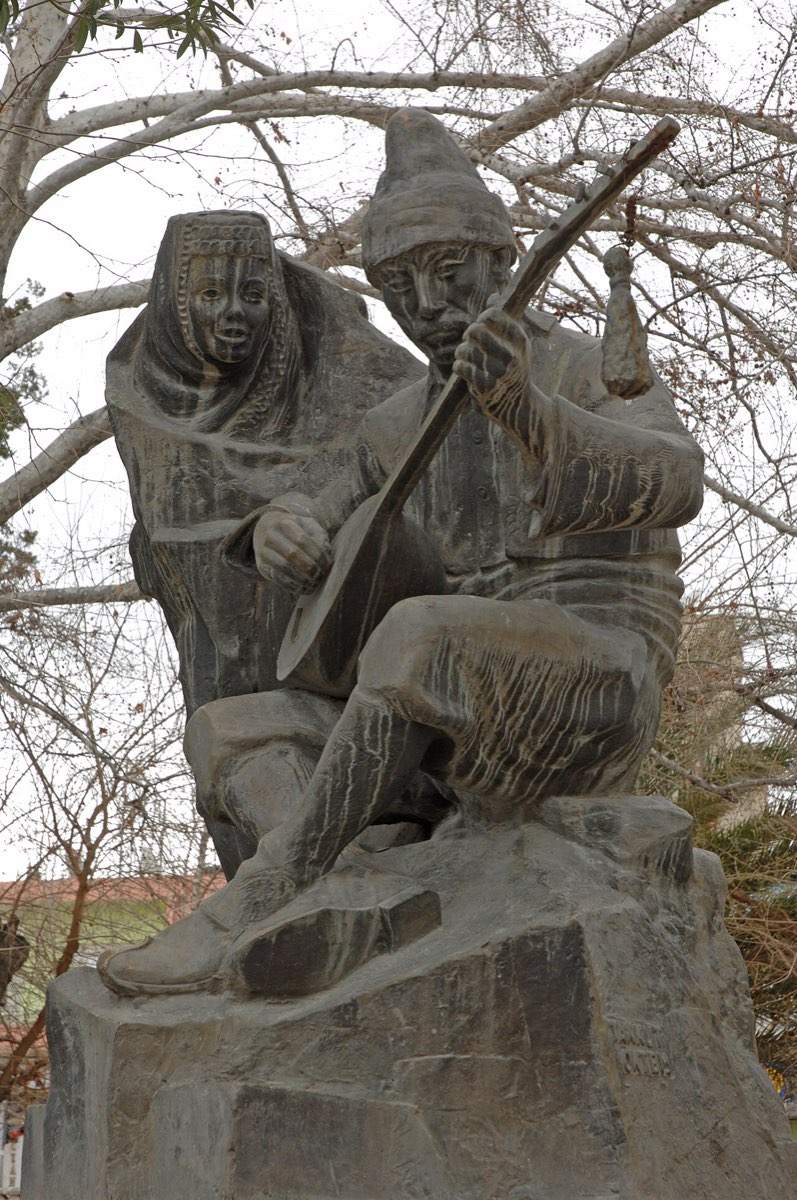
He is one of our saz poets who lived in 17th century. These poets strolled in many villages and told poems in the coffeehouses, quarters and weddings. Thus, they were called folk poets. Karacaoglan is a folk poet from Southern provinces.
He was born in Fersak village of Adana in 1606. He is from Sailogullari. This family still survives in this region. He started to play saz and tell poems when he was young. He entered Janissary Organization. He took part in wars. He has a Divan.
They called him Karacaoglan.This was because he was very dark. He was one of the bronze faced and heartsick youths of Adana. He had a lover with night and coal black eyes, black hair, dark complexion. Karacaoğlan called her "Karakız", and she called him "Karacaoglan". Villager girls, Fersaklis, Kozanlis, Bahçe district people were jealous of their love. Not only they, but also Kozanogulları were jealous of Karacaoglan's being so much loved.
One day they wanted to kill him because they were able to. Karacaoglan, seeing that he would be killed, hanged his saz on his neck one winter day after he woke up and said:
İncecikten bir kar yağar
Tozar Elif Elif diye
Deli gönül hayran olmuş
Gezer Elif Elif diye...
and departed. That was his final departure... He could neither see Karakiz again, nor turn back to Fersak. But Elif's love was burning his heart. He saw Elif in all girls he looked.
Karacaoglan went as far as Van, strolling. He passed to Iraq from there. Then he went to Arabia. Then Iran. He was protected in anywhere he went, and became the favorite of people.
He told poems in all kinds such as Ballad, folk song, mâni, varsağı, kayabaşı, triplet, threnody, praise, epical folk poem, epics. He wrote with eleven syllables most. This was appropriate for his instrument. Once he took his hemming stitch on his saz, he could easily go on.
His poems could be easily memorized because of his easy and comfortable saying, in a way not to be deleted afterwards. Therefore, his sincere sayings separated among the people for centuries like Yunus hymns. Other poets were inspired from him, and even tried hardly to say poems near his tongue. Some of them could not succeed, and replaced his name with theirs. Thus, there are many Karacaoglan's poems which are referred to as others'.
Karacaoglan's sayings were always simple and pure Turkish. He did not take care of prosody. He got excited, he said. The hemming stitch of his saz and his delicate words made him become a myth in all over Anatolia.
Elif kaşlarını çatar
Gamzesi sinemi yakar
Ak elleri kalem tutar
Yazar Elif Elif diye
Several books were written on the real personality of Karacaoglan, essays of whom were obtained after centuries. Karacaoglan still lives in our hearts as one of the troubadours words of whom are depicted with all their vividness and loved by the people.
Karacaoglan died in 1674.