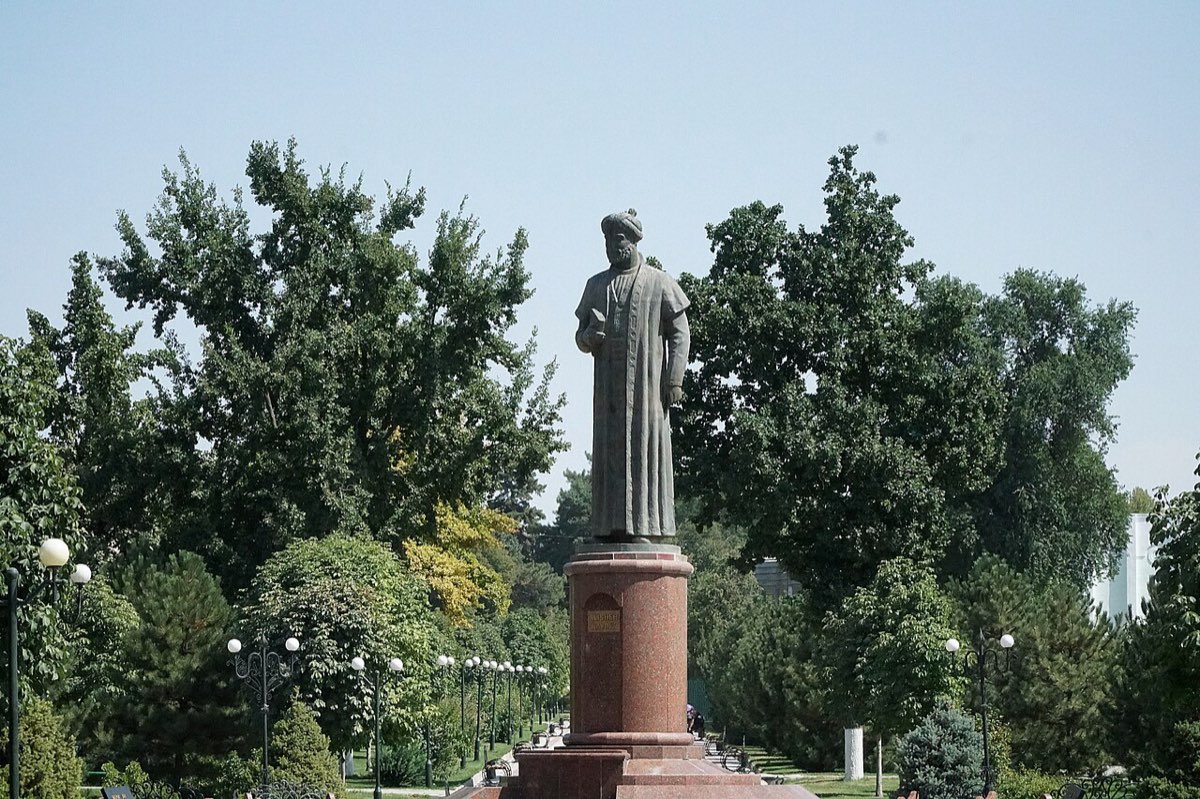
Ali Sir Nevai is a scholar and statesman trying to make Turkish a supreme language of art, advocating this idea and valuing Turkish language. He was born in 1441 in Herat. His father was Kiçkine Bahşi, one of the viziers of Sultan Ebû Said, one of the meliks of Timur. Ali Şîr Nevâî was first educated by his father. He went on his education in Horasan and Semerkant. Sultan Hussein Baykara was his school friend. They had even promised each other to remember. Sultan Hussein Baykara, when he was enthroned in Herat, called Ali Şîr Nevai as they had agreed. He found out that he was in Semerkant and wanted the melik of Maveraünnehir, Ahmed Mirza, to send Ali Şîr Nevâî to himself with a letter. Ali Şîr Nevâî was taken to Herat by the men of Ahmet Mirza. Sultan Baykara initially appointed him as sealer. Then he appointed him as a vizier.
Ali Sir Nevai, whose job allowed him to read lots of books, have conversations with scientific environments and making researches, got bored of his duty after a certain period of time. Even if he presented his petition of resignation to Hussein Baykara, it was not accepted. On the contrary, he was appointed as the governor of Esterebad. Ali Şîr Nevâî did not remain much in this post and left it in 1490.
Ali Sir Nevais family was very rich. Therefore, he did never receive salary from the state, but gave money. Ali Şîr Nevâî loved serving the community and humanity. He established various associations because of this idea. After leaving his duty as governor, he concentrated on science and art. He passed away in Herat in 1501, in which he was born. Ali Şîr Nevâî, wrote his poems in Turkish and Persian, but he knew Arabic very well. Mullah Cami, one of the well-known scientists of the age, is one of his poem-pals. Ali Şîr Nevâî, who is known as the person serving Turkish language most except for Kaşgarli Mahmut, compared Turkish and Persian in his book named Muhâkemetül-Lügateyn and advocated superiority of Turkish language in many sections. Ali Şîr Nevâî wrote this book fro people writing books in Persian language abandoning Turkish language. Ali Şîr Nevâî, used the pen names Nevâî and Fani, in his poems written in Turkish and Persian, respectively.
Ali Şîr Nevâî has five separate divans, four being in Turkish and one in Persian. The general name of his Turkish divans is Hazâinül Maânî. His divans in Turkish are named Garâibüs-Sağîr, Nevâdirüş Şebâb, Bedâyiül-Vasat and Fevâidül-Kiber. Ali Şîr Nevâî, who wrote the first hamse, with his Hamse, consisting of his five mesnevis. Ali Şîr Nevâî has 18 more books except for his divans. These are as follows in turn: Hayretül-Ebrâr, Ferhat ve Şirin, Leyla ve Mecnun, Seba-i Seyyârem, Sedd-i İskender, Lisânüt-Tayr, Muhâkemetül-Lügateyn, Mecâlisün-Nefâis, Mîzânül-Evzân, Nesâimül-Mehabbe, Nazmül-Cevâhir, Hamsetül-Mütehayyirîn, TühfetülMülûk, Münşeât, Sirâcül-Müslimîn, Tarihul-Enbiyâ, Mahbûbül-Kulûb fil-Ahlâk, Seyfül-Hâdî and Rekâbet-ül-Münâdî. Ali Şîr Nevâîs books were read with pleasure both in the era in which they were written and afterwards in nearly all of the Turkish world. Many famous Turkish poet accepted him as a model and appraised him.
Great Ottoman Poet Ahmet Pasha, who lived in 15th century and famous Fuzuli, who lived in 16th century and wrote in Azeri dialect were both influenced by Ali Şîr Nevâî. Many Ottoman intellectuals and Yavuz Sultan Selim were admirers of Nevâî. Even Nedim, our great divan poet of 18th century wrote poems in the language of Ali Şîr Nevâî (Jagatai dialect).
Many poets from Turkey wrote poems similar to that of Ali Şîr Nevâî. Such influence showed itself even in Post-Political Reforms period and the anthology book consisting of three volumes named Harâbât by Ziya Pasha contained many of Ali Şîr Nevâîs poems. In all literature histories published today, Ali Şîr Nevâî is appreciated for his knowledge, wisdom, art, Turkism and positive influences.
It is useful to mention about the book named Muhâkemet-ül-Lugateyn in particular by Ali Şîr Nevâî who dedicated his whole life to promotion of Turkish language for reflecting his thoughts on Turkish language. The book by Ali Şîr Nevâî, Muhâkemet-ül-Lugateyn, can make 50 pages of a small size book with our letters of today. However, this book which is small in size, is big with regard to its content. Here are some sentences from Muhâkemet-ül-Lugateyn. ...The jovial nightingale of verse garden, Ali Şir with Nevai pen name (May god forgive his sins and conceal his disgraces) presents as follows: Speech is such a pearl that its sea is the heart and heart gathers all meaning in itself. As a matter of fact, divers get the jewels out of the sea and these are evaluated by jewellers. Those honored enough to get speech pearls out of heart (divers) are the specialists of this work. These pearls are revived by these specialists and become famous in proportion. Pearls are very different with regard to their values. Some cost one lira and some thousands of liras. Are the cheap exchanged pearls equal with the pearls which constitute earrings to the ears of sultans?
...We know that Turk is smarter, more intelligent, more innocent and strong than Persian. Persian seems more mature and deep in science and understanding obtained by means of effort. This is obvious from the upright, honest and clean intentions of Turks and science and wisdom of Persian. However, there are many differences between Turkish and Persian languages in terms of perfectness and deficiency. In speech and indication, meaning and perception of words, Turk is superior to Persian. There are so many fine points, beauties, arts in Turkish native language we shall study in appropriate place...
...Is there a clearer evidence of Turkish superiority, skillfulness, clearness and brightness compared to Persian than those: The unity between the old, elder and youth of these two nations is of the same degree. Their trade, businesses, efforts, manners are in no way different. They live in the same life conditions. However, all of the Turks can easily learn and speak Persian. Nevertheless, no Persian is able to speak Turkish. Maybe one in a thousand learns and speaks Turkish, but his first word reveals that he is not a Turk. There is no stronger evidence that Turk is more skillful than Persian, and no Persian can claim otherwise...
Persian language is inadequate in talking about high and deep issues. Because, there are many fine points, and peculiarities in formation and subjects of Turkish. There are words created for delicate differences and even most volatile concepts which cannot be easily understood if not explained by well-informed people.
... The ignorant and miserable youths of Turk try to say poems in Persian thinking that it is beautiful. If they had thought in a detailed manner, they would have understood that it was easier to say poems and show arts in Turkish with its so much breadth, details and richness which would make their poems more appreciable.