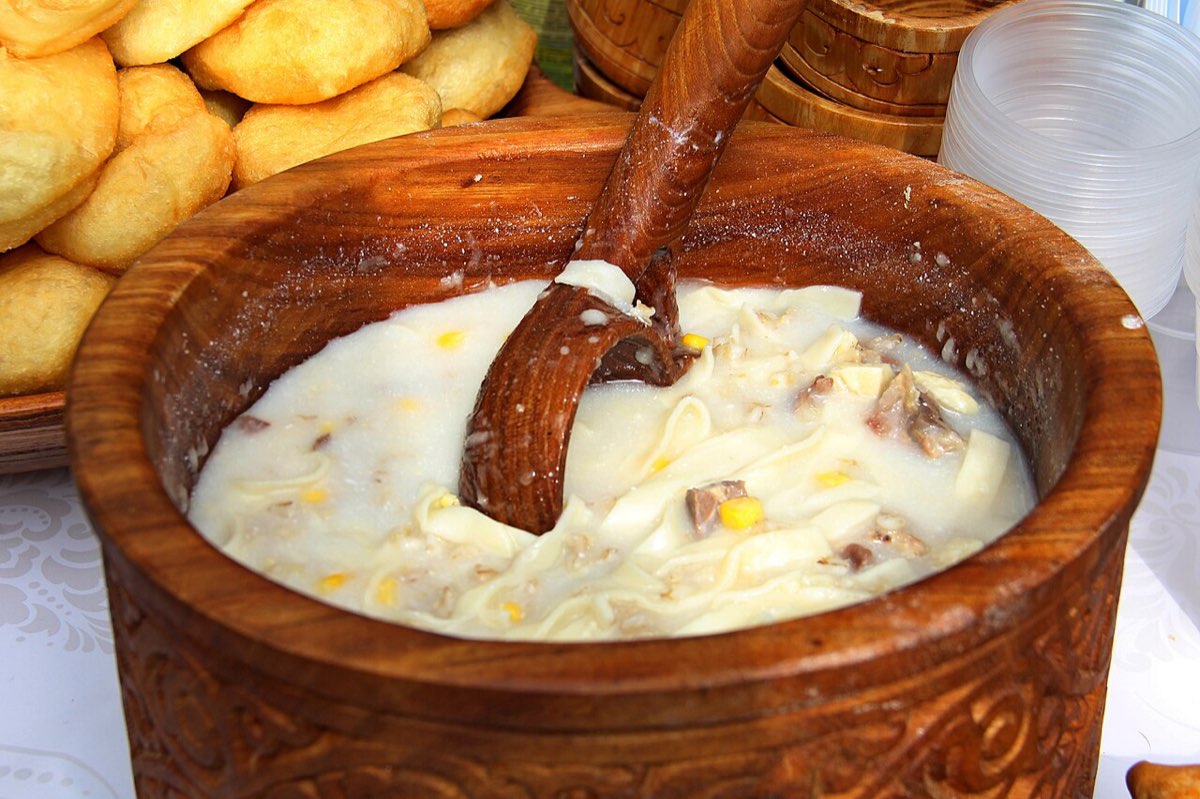
There is a "Cılgayak" feast celebrated on the day equivalent to 21st March among the Altay Turks. This feast, like Nevruz, is celebrated as the feast for the revival of the nature and entering into a new year. The preparations of this feast start in the summer.
Kandık, first plant of the year, and their roots called "sargay" are extracted and various food types are prepared from them. In addition, yoghurt with honey, frozen and dried meat, meals from sheep are prepared. Four types of cereals are prepared. Arçın is left on each of the four types of cereals when sun feast is celebrated, meaning when the time comes to go out on the countryside. Arçın is exposed to fire. The adults play games like the children. On the way back to village in the evening, everybody sings aloud. One of the proofs showing that Nevruz is a spring feast is the Isıakh Feast among Saka Turks.
Dr. Yakup Deliömeroğlu, providing the first information on this feast says: "Among Saka Turks, where Sky of God traditions are dominant, Isıakh feast is one to thank God for the oncoming of the spring and a productive year. The Turkologs of Saka Turks and the people know that Isıakh feast originates from Turkistan. The dates of 21-22 June are privileged for the sun system like the Nevruz; because it is the longest day of the year. On the other hand, the spring is just felt in Siberia, where Saka Turks live.
The ceremonies start with the prays by Ak-shaman and his cleaning the ceremony area by koumiss. New birch trees are planted to the ceremony area in the shape of half moon. A fire is set on the square and this fire is nor put down until the end of the ceremony. It is believed that the evils of the previous years are dismissed and any harm of them to the new days are prevented by the pouring of koumiss to the ground, prays and the fire set by prays of the Ak-shaman. Everybody, especially young women and young men tie pieces of clothes to the birch trees wishing things that they wish to become true in the new year. This belief and custom still survives among all the Turkish peoples throughout the world.
The first documents related to the Isıakh feast are found among the notes of Idesa, the Dutch traveler. Idesa writes that Isıakh is the only feast of the Sakas during his travel from Siberia to China in 17th century. He tells about the joyful celebration of the spring by the Saka people, setting of the fire and putting it our after the end of the ceremony, preparation of koumiss in large quantities, the cleaning of the floor by pouring koumiss and offering the visitors this drink.
Isiahj, among the traditions that still survive today, is integrated into the customs, traditions and agricultural activities of Saka people. Sakas congratulate this feast as the oncoming of the new year on 21-22 June. They celebrate this feast as the renewal, integration of nature and man, beginning of the good, clean and bright and the day of connection to the future with hope.
After a long winter, the Saka people come together and have fun; koumiss is drunk during the feast, shish kebap cooked on site is consumed, national games are played; wrestling, horse races, Olonhosut races and Osohuay dance are performed. Olonhosut race is a Siberia sport performed by holding up rock parts and throwing backwards from the shoulder. The same sport is extensive among Hakas living in Siberia and other Turkish peoples. Osohuay, on the other hand, forms an essential part of the Isıakh ceremonies. After koumiss is drunk and some competitions and plays are performed; the people who make a row by holding each other's fingers, as in the halay in Anatolia, start dancing around the fire or performing halay. Some myths claim that this halay continues for 9 days." Isiakh feast, still celebrated today, is declared as the official holiday in Saka Republic after it was founded in 1991.
The research related to the "pedigree" of the Indians in America gives interesting information about fields where Turkish culture is extended. Dr. Ahmet Ali Arslan (alias Garip Kafkaslı) gives the following information about this issue: {Although "gene" research by independent researcher experts on human bones and human fat remains in the soil in Siberia, Alaska and south of Alaska during recent years reveal that the people, who lived in these continents once in a while, are close relatives, those who come to America via Europe turns their backs on these facts.
It is very significant that the customs and seasonal religious ceremonies of American Indian tribes and old Turks living in Siberia Saka, Altay, Hakas, Telvit and Tuva are very similar and parallel to each other. In spring, soil, water and air give the color of their friendship to the flowers. The celebration ceremonies and festivals performed for the "beginning of the new year" are among the outstanding seasonal feasts celebrated with religious ceremonies among the Indians, involved in agriculture and soil. The settled Indian tribes having their own cities in the state of California have greater loyalty to the celebrations of "the Beginning of the New Year" in comparison with those living a nomad life, migrating to cool mountain slopes skirts in summer and to warmer and more reasonable regions, living on fishing. Such celebrations are performed in order to "celebrate transition from the old year to the new one, getting out of death and revival, being rescued from infertility and return to fertility".
Yurok, Karuk, Hupa, Yuki, Pomo, Modoc and Maidu Indian tribes living in California and surroundings celebrate spring feast in the March, accepted as the beginning of the new year as a symbol for "Rebirth" in relation with the revival and awakening of the nature. During ceremonies that Indians perform in relation with "revivification" celebrations in March, a long and straight pole is erected in the middle of the village or camp where the tribe lives. The Indian tribes living in New Mexico, Arizona and California believe that this pole, erected in the middle of the village is the axle of the universe and that it represents "One" that created the world. This belief is also extensive among the pueblo Indians, meaning settled and having a city.
One of the most important aspects of the celebrations and ceremonies of the Indians is that, the Shaman of the tribe climbs up the pole in order to be closer to "Great Spirit", accepted as "God of Skies" and to beg for His help and God's mercy for his tribe. The purpose for the shaman, who runs this ceremony, is to protect his tribe from evil spirits and the illnesses caused by them and to be closer to the God of the Skies in order to request rendezvous for abundant products. The ceremony of climbing up the pole is very prevalent among Camelia Indians in California state.
Iron is an integrating element in the belief of the Turk. The motifs of "melting and divinity of iron" is also extensive among the Indians. They also respect iron and absolutely carry iron edged weapons with care especially during new year celebrations. North Indian Americans also attribute great importance to iron, which is very important in Turkish cultural history and significant seasonal ceremonies, and some people are strictly forbidden to touch weapons made from iron, which are considered to be divine. In Algonquain Indian tribe, it is forbidden for a pregnant woman to touch weapons made from iron and steel. Especially pregnant women and unauthorized people are banned from touching the weapons of the tribe fighters, with the fear that lethal force of the weapon may be lost. In contract with the all-pervasive belief, none of the Indian tribes worship the totem they erect in spite of all these bans.
Among Yakutat and Tlingit Indian living in the south of Alaska in America, the iron is approached with the respect shown by Turks in Siberia. {Like the other Indian tribes, Yakutat and Tlingit Indians show great respect and concern for the knives and axes or the iron which they use to make sharp edged weapons.}
The traces of the Turkish shamanism and Indian shamanism are found intensively in the "beginning of the new year ceremonies". In addition, there are the parallel aspects.The new year ceremonies, celebrated in every March, are also found to be existent among "Aravak" and "Manai" Indian tribes living in South America, Bolivia in parallel with Turkish shamanism. Moreover, there are records that "Arıkara" Indian shaman living in Mexico state of America performs the same rituals with the Turkish shamans in spring. Such remains are the remains of Shaman culture, so, Turkish culture, which passed from Asia to America.