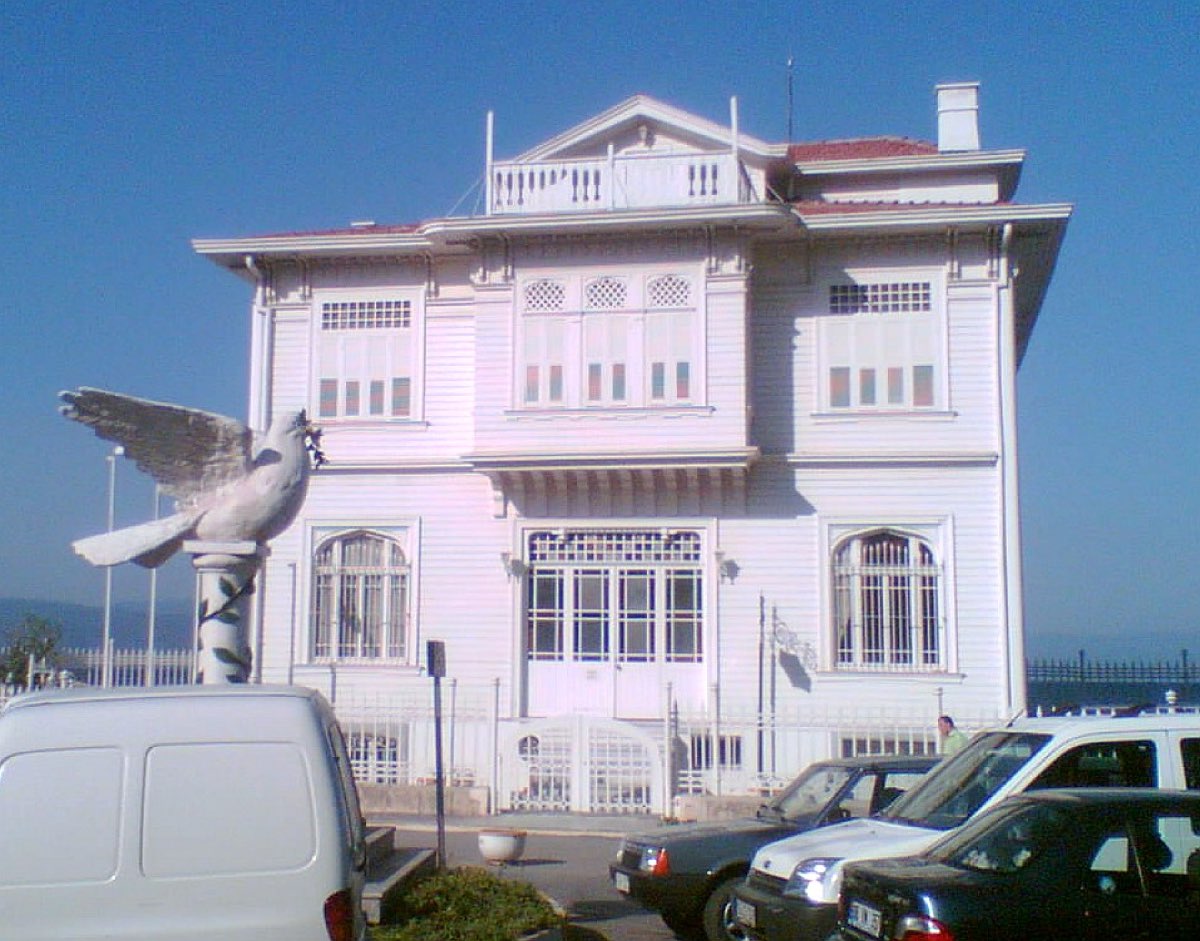
Armistice Agreement
Pursuant to the capture of Izmir, the national forces advanced towards Çanakkale in order to wipe off the Greek army from the Thrace. Upon this event, Lloyd George got flurried and he immediately wanted reserve forces from his colonies in order to defend this region that was his last base and support for the maintenance of his prestige in front of his country. However, it has been understood that this demand of him was rejected and any forces that would constitute the backup troops did not come to the region. Meanwhile, General Pelle who was French Extraordinary Superintendent in Istanbul came to Izmir in order to meet with Mustafa Kemal. His purpose was to establish a zone under the name of buffer state and to prevent the penetration of Turkish armies into this zone. Mustafa Kemal declared that the national government did not recognise such a region and that the armies would not stop before the recapture of Thrace. When General Pelle understood that he was unable to work out a solution, he declared to Mustafa Kemal that Franklin Bouillon from France would come to meet him as a representative in the name of the government. Franklin Bouillon who came to Izmir with a warship said that he carried out these negotiations upon the approval of Italian and English governments. However, while Mustafa Kemal was in a meeting with Bouillon, a memorandum was received from the Allied States that was signed by the Ministers of Foreign Affairs on the date of 2nd September 1922. In this memorandum, it was recommended that the war would be stopped and a conference would be carried out. The stance of Mustafa Kemal was obvious and definite. He would not give up fighting unless he captured the entire Eastern Thrace. However, he would absolutely not keep on fighting in case that the enemies would spontaneously retreat from these regions. In this memorandum, it was also stated that the Thrace extending towards the River Maritsa including Edirne would be surrendered to the national forces providing that these national forces would not land troops in the buffer zone in the straits. Furthermore, the issues about the straits, minorities and our entrance into the League of Nations were also included within this memorandum.
Moreover, it was promised that the Allied States would resort to their own forces in order to repulse the Greek troops beyond a line to be drawn by the commander of the Allied States. Therefore, it was recommended that a meeting would be organised in Mudanya or Izmit in relation with this issue.
Mustafa Kemal sent a short and brief reply to this memorandum on the date of 29th September 1922. He stated that he accepted the organisation of the conference, but he wanted that the Thrace extending towards the River Maritsa should be immediately surrendered. He also declared that the conference would be carried out in Mudanya on the date of 3rd October as he had determined. He stated that he had appointed Ismet Pasha, the Commander of the West Front Armies as the delegate to participate in the conference.
The Allied States were in a difficult situation. They were accustomed to declare their demands in the form of orders to the government in the periods of the Ottoman Government. However, Mustafa Kemal was the powerful party under these circumstances and they had to obey his demands and desires. This situation would follow a gradual progress in favour of Mustafa Kemal day by day.
Mudanya Conference was opened on the date of 3rd October 1922. It was expected that this conference would resolve three main purposes:
The establishment of the state of cease-fire between the armies.
The determination of the line that the Greek armies would retreat beyond in order to evacuate the Eastern Thrace.
The determination of the methods and means for the settlement of the TBMM officials and gendarmerie forces in the places to be abandoned by the Greek soldiers.
In this conference, England was represented by General Harrigton, France was represented by General Charpy, and Italy was represented by General Monbelli.
There were various problems with secondary significance in relation with the resolution of the three main issues that we have stated above. Therefore, the meeting was dragged on due to the allegation and supposition of various recommendations in a reciprocal manner. Ismet Pasha was obstinate in relation with his demands. He insistently stated that the Thrace should be evacuated by the Greek forces; and that the forces of Allied States should abandon the country as soon as possible and the Turks would be free to send gendarmerie forces into this region as much as possible.
Since there was not an agreement among the Allied States, England seemed to be flabbergasted what to do under these circumstances. Lord Curzon wanted to provide the action of the French forces in accordance with his desires. Therefore, he obtained some information from General Harrigton and went to Paris in haste. He received the promise of Poincare for the invasion of the Eastern Thrace by the Allied States for a specific period and the collective cooperation in respect of the pressure to be imposed on Turks for the recognition of a buffer zone. He notified this instruction to Mudanya. Harrigton obtained information and orders from his own government. In the same way, Ismet Pasha received the instructions from Mustafa Kemal who was in Ankara through telegrams and he asked the degree of the compensations to be made. Upon the last instruction that he had received, Harrigton decided to assume a firm attitude. In case the Turks did not accept their desires, he would declare that the only way left would be war under these circumstances.
It was observed that the atmosphere had become yielding in the meeting that was organised after two days. Ismet Pasha pretended to have accepted some of the demands of Harrigton. However, he actually had accomplished his demands. As a matter of fact, pursuant to the signatory ceremony, Harrigton had stated that We were two foreigners in the beginning, but we are separating as two friends now. Ismet Pasha had not heard these words; however, he also stated that this date was one of the significant memories of his life. The resolutions taken in Mudanya Conference that was signed on the date of 11th October 1922 were as follows:
The armed fights between the Turkish and Greek forces shall be stopped from the enforcement date of the agreement (the agreement would come into force after three days pursuant to its signatory at five).
Commencing as of the enforcement date, the Greek armies shall retreat to the left coast of the line that extends from the place where the River Maritsa flows into the Aegean Sea towards the point of the border between the Thrace and Bulgaria.
Since the enforcement date of the agreement, the Greek soldiers shall start to evacuate the Eastern Thrace and this evacuation shall be completed within fifteen days.
Upon the retreat of the Greek officials from each administrative region, the civil administration shall be surrendered to the officials of the allied states and these officials would deliver the same to the Turkish officials on the same day as much as possible. These delivery transactions in relation with the entire region of Thrace shall be completed within maximum thirty days pursuant to the evacuation of the Greek forces.
The TBMM armies would stay within the specified lines in Asian lands until the opening date of the peace conference and during the conference. Upon this provision, it was stipulated that the Allied Forces should stay in the Dardanelles and Istanbul Straits until the establishment of the state of peace.
The surrender of Thrace to the TBMM government was accepted in Mudanya Armistice Agreement. Under these circumstances, the target of the War of Liberation oriented towards the National Pact was accomplished thereof. The final results would be obtained in Lausanne Conference.