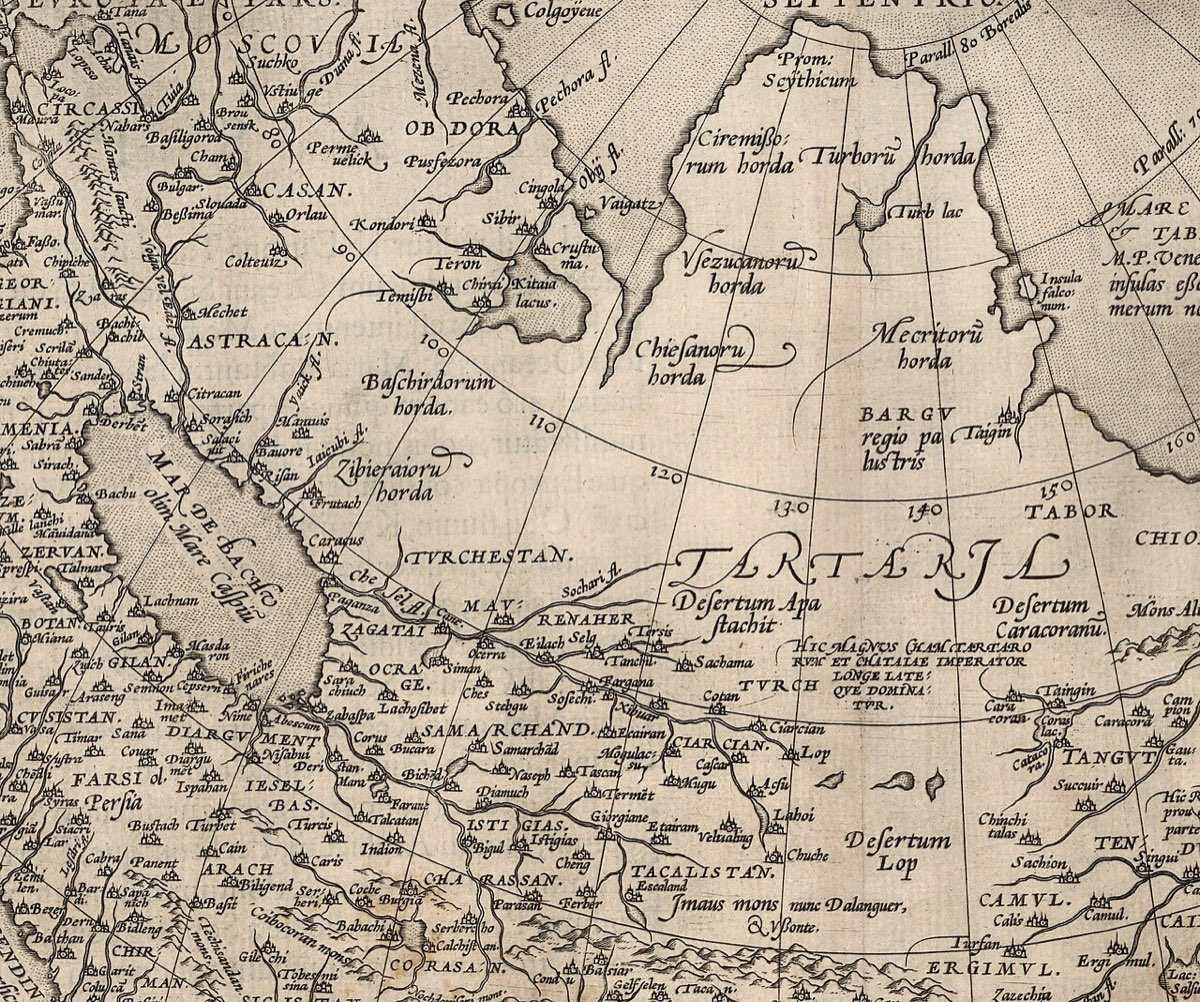
The banks of Irtish River had been a region where various Turkish-Kipchak tribes lived in since the century I DC. A Khirghiz khan named as Inal that established dominion in the eastern region of Sibir had become submissive to Jenghiz Khan. Then, his regions became a part of the Mongolian Empire. Afterwards, they were submissive to Coci (Cuci) Country and therefore to the Golden Horde State.
Pursuant to the disintegration of the Golden Horde State, the (western) Sibir (Siberia) Khanate was established. The first ruler of this khanate that has been known was Mamik's son, Tayguba. Jenghiz gave him the banks of Irtish, Tobul, Isim and Tura Tivers. The capital city of this khanate must have been today's Tyumen city (or a place near to it); its name in those periods was "Çinki" (or Çimki)-Tura. Afterwards, this city was called just with the name of Tura.
Pursuant to Taybuga, his son, Hoca Khan and then his son, Mar Han had ascended the throne. Mar Han got married with the sister of Opak who was the leader of a small tribe connected to Kazan Khanate. In the course of a struggle between these two persons, Mar Han died. Then, Mar's sons were taken to the palace of Opak and the Siberia Khanate was under their domination. Mar Khan's grandsons, Muhammed and Angiş ran away from them and established dominion in the country of their grandfather. Muhammed Khan left the old centre; and he moved the centre to the capital city of "Isker" (Iskir or Kışlak), a much safer place that was located over the Irtish River (at a higher place of today's Tobolski with a distance of 17 km). The sultanate of Yadigar that was the last member of this dynasty is contemporary with the invasion of the Kazan Khanate by the Russians.
The invasion of Kazan (1552) that was the strongest castle in the west had an enormous effect in Siberia. Under these circumstances, Yadigar Khan sent envoys to Moscow in the year of 1555 in order to diminish the approaching Russian threats and to prevent the attacks from the Turkish-Kazakh-Khirghiz steppe lands in the south. He congratulated the Russian Tsar Ivan due to his successes and he wanted his demand to become submissive to his domination. Upon this event, the Moscow emissary came to Isker. In his return to Moscow, an envoy of Yadigar accompanied him and the envoys and emissaries were sent to each other reciprocally in the year of 1557.
Meanwhile, Yadigar was involved in some struggles with some steppe khans in order to maintain his domination in Sibir. Yadigar's greatest rival was Küçüm Khan that was rumoured to have been from the lineage of Siban who was from Jenghiz dynasty.