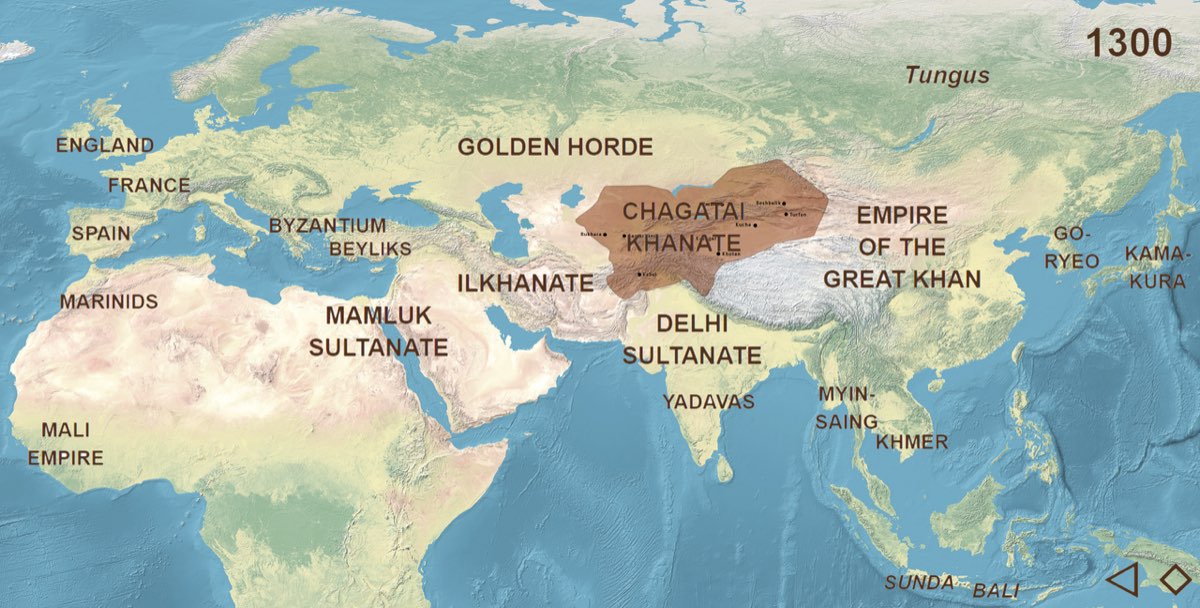
The establishment of a separate dynasty in Turkestan branch of Jenghiz Empire called with the name of Chagatai took place pursuant to the death of Chagatai. Although this region was given to Chagatai in the period of Jenghiz, it was not ever dominated in an independent manner by Chagatai. The older Turkish dynasties in this region remained in their places. They were administered in the name of the great khan by Mahmâd Yalavaç and his son, Mesut Bey that lived in Transoxania and Hucent that we have observed in this province in the further periods. The first khan of this region from Jenghiz family was Kara Hulagu (1242-1247), and the Khan Guyuk has appointed Caghatai's son, Yisu Mengu as a successor of him. After the struggles that resulted with the disintegration of the empire, Caghatai's grandson, Algu annexed some parts of the Harezm country and Afghanistan to the Eastern and Western Turkestan and he established a union that was dominated by Caghatai sons. Pursuant to the death of Algu (1266), the sovereignty passed to Kaydu from Ogeday family and then to his son, Capar. However, the sovereignty was again transferred to one of his sons, Duva (1291-1306). The civil wars that led the empire to disintegration had partially undermined the economical situation of Turkestan. Therefore, a constant stability could not be attained. Diva had tried to establish a general state of peace among Jenghiz's sons in order to develop the economical situations; but his efforts fell short.
When Tarma ascended the throne (1326-1333), he adopted the religion of Islam and reinforced his economic relations with the other Islam countries in the Transoxania. On the other hand, he caused the rebellions of some of the tribes in the eastern section since he had violated the rules of Jenghiz. The centre of the state that had moved from one place to another for several times was also changed in the period of Kazan (died in 1346). The capital city was moved to the city of Karşi in Transoxania and the Islamic effect over the administration became definite from that date on. As a result of the struggles that grew violent between khans and the military commanders since the beginning of the years of 1346-47, the central power was too attenuated and the administration was under the dominion of the commanders that oriented the khans although there was an official khan as the leader of the state that was a member of Jenghiz family. This situation continued until the period of Tamburlaine with trivial changes.