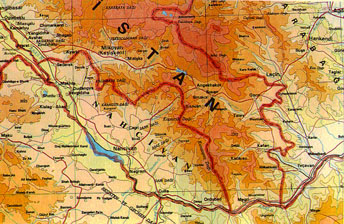
Nachicevan is the name of a historical city located in the Southern Caucasus and the region surrounding this central city. It is located in the left side of the River Aras and it is separated from the lands of Iran through the borders of this river. The city of Nachicevan and its surroundings are considered as one of the most significant historical centres that have lived almost all the eras of the history. In terms of its geographical position, it has always constituted an important point of transition and communication between the east and the west in history.
In the course of the battles that burst between the Sassani State founded in Iran and the Byzantines that possess the Anatolian lands, Nachicevan would change hands between these two parties. In the period of the Excellency Caliph Osman, Nachicevan was conquered by Halil bin Maslama. Pursuant to this conquest, the Arabian governors succeeded in making this region to become one of the principal military centres. The Islam State used this region as a base against the Byzantine. After these first governors, Nachicevan was under the domination of various Arabian dynasties. It has played an important role as a transitional corridor while Turks were moving ahead to Anatolia from the Middle East. In the century XI, this region was conquered by Seljuks and it was then administered together with Azerbaijan by the Seljuk princes and Seljuk governors.
Ildeniz Atabeys ruled and reigned in Nachicevan between the years of 1136-1225. (İldeniz people, İldeniz Sons, Azerbaijan Atabeys). This city has turned into a modern and significant centre in terms of economic and social life under the reign of Atabeys. Then, Nachicevan and its surroundings were invaded by Harezmshah State and it was reigned by them for a little while. Afterwards, the region was occupied and invaded by Mongols just like the whole Azerbaijan lands. Nachicevan was one of the most significant centres of this state until the collapse of the İlhanlılar (Ilkhanate) State that was founded by Hülagu Khan from the Mongols.We observe that the city of Nachicevan and its surroundings as well as several regions of Azerbaijan were captured respectively by Kara Koyunlular, Timurlular, Ak Koyunlular, Safeviler and Ottomans. Therefore, the region has become one of the most significant and considerable cities of the Turkish world since the conquest of Seljuks.
Actually, the city and its surroundings was the most effected region in Azerbaijan that was under the influence of the continuous struggles and battles that lasted between Ottomans and Safevis for a period of more than two hundred years. It was worn out from time to time due to these struggles. But occasionally, it was provided with significant levels of prosperity and public works by both states. Azerbaijan would continuously change hands in the course of the struggles between Ottomans-Safevi States. Under these conditions, the Azerbaijan Khanates that took the advantage of the turmoils that burst out after the murder of Afshar, the Shah of Nadir declared their independency. Under these circumstances, Haydar Kulu Han, the chief of Kengerli Clan that was one of the most powerful organisations around Nachicevan got rid of Ağa Khan, the substitute regent of Shah in the city through the support of the other local beys. Then, he declared his own khanate in the region.
The lands of the Khanate included the city of Nachicevan and the districts of Sherur, Ordubad, Megri, Gafan and Culfa. Willing to provide prosperity for his khanate and comfort for his people, Haydar Kulu Khan tried to develop the commerce and agriculture within the borders of his khanate. However, he was insufficient in terms of military conditions. Therefore, the khanate had to recognise the domination of Penah Khan from Karabag for a while. In the lighting of this sentence, we can understand that Penah Khan who was accompanied by the forces of Gence Khanate and the Georgian Kingdom created an alliance together with his own forces against Şekilli Hacı Çelebi Khan in the year of 1752 and added the Nachicevan Khanate to his lands. Pursuant to the death of Haydar Kulu Khan, Hacı Khan Kengerli became the Khan of Nachicevan . However, under his reigning period, the khanate gradually lost its power and got under the influence of Itan. Hacı Khan was abducted to Shiraz by the Ruler of Shiraz, Kerim Khan Zend and he was seized and arrested there. The activities of Kerim Khan Zend in Iran and particularly in Azerbaijan were followed by the advance military parties of Ottoman State. The Ottomans tried to get prepared and ready against the possibility of any kind of unexpected events.
In the year of 1770, Ali Kulu Khan was granted with the right of domination in Nachicevan thanks to the support of Kerim Khan Zend. However, his reigning period did not last for a long time. Three years later, Veli Kulu Khan was the ruler instead of him until the last years of Kerim Khan Zend (1770-1779). Nachicevan felt the strong influence of Iran and since the years of 1780, it was getting under the influence of the other powerful Azerbaijan khanates and the Georgian Kingdom. For example, the Ruler of Hoy, Ahmed Khan enthroned Hüseyin Ali Khan from Revan to the position of Nachicevan Khanate in the year of 1873. As for the year of 1787, Halil Khan, Khan of Karabag get into alliance with Avars and attacked to the khanate. One year after this attack, Kelb Ali Khan was enthroned to the khanate. The articles and writings sent by İbrahim Pasha, the governor of Erzurum who followed the regional development and informed the capital of Istanbul about the actions shows us that Kelb Ali Khan had attacked to the Khanate of Karabag and plundered some of the villages. Having established good relationship with Hoy and Revan Khanates, Kelb Ali Khan was on strained terms with Ibrahim Khan. In the year of 1792, he was able to do away with an attack organised by him, but the peril of Iran was threatening entire the region (the threat of Aga Muhammed Shah Kaçar towards the region of all Azerbaijan). Against this threat, the two khans had to constitute a forced relationship for they had been obliged to act together.
to be continued