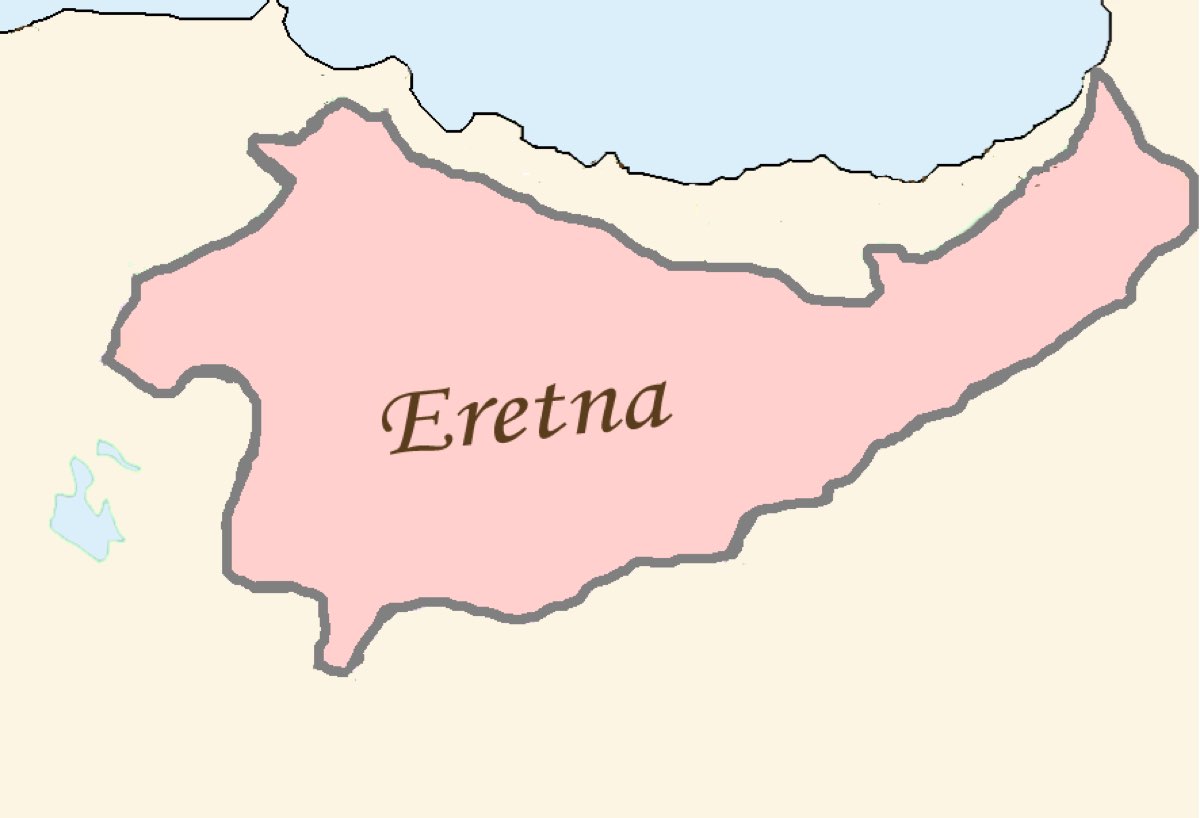
gullari Principality
Eratnaogullari principality had been the most important inheritor of the Ilhanli State in Anatolia. The State had survived for 53 years between the years of 1327-1380. Eratna Bey had been the general governor of Anatolia connected to Ilhanli State for eight years between the years of 1327-1335. He acquired independence in the year of 1335. However, he had to be submissive to the Mameluke State for 5 years between 1338-1343. From that date on, the state continued its independence. The capital city was Sivas in the beginning, but it was then moved to Kayseri. Just like all the other Anatolian Turkish states, Eretna State was the member of Sunnite-Hanafi sect. Eretna or Ertana Bey who was the founder of the State (original name was Ertene, but it has been cited with the form of Aratna in the Uighur texts) was not a Turkmen person; he was from Uighur beys in the service of Ilhanli State. His father, Cafer Bey had died in Kayseri. Various Uighur Turks had come to Anatolia through the Eretnaogullari principality.
4 rulers had reigned in the state on the basis of inherited sovereignty. These rulers that had considered themselves as the official successors of Ilhanli State were called with the title of sultan, but they were frequently named as Bey. These rulers respectively were Eretna, Mehmed, Ali and Mehmed II Beys. Eretna Beys sister was married to Emîr Coban's son, Emîr Demirtaş who was a famous Ilhanli commander. His paternal aunt was married with Nûre-Sûfî Bey who had been the ancestor of Karamanogullari principality. His brother was Barak Bey and Barak Beys son Mutahharten Bey had played an important role in the fights between Yıldırım Bâyezid-Timur and he had been on the side of Timur in the course of these fights. He had been the Bey of Erzincan for approximately 29 years since the year of 1375 and until the year of 1404. Mutahharten Bey had also been the bey of Erzurum bey in the year of 1379. Erzincan had been under the domination of Osmanogullari principality for 1 year between the July 1401 and the date of 28th July 1402. Upon this event, Mutahharten Bey had taken shelter in Timur. Mutahharten Bey had been the Bey of Bayburd in the beginning.
Eretna who was the founder of this principality had been from Uighur Turks and he was in the retinue of Timurtas who was the governor of Anatolia connected to the Mongolians. It was a principality founded in the Central Anatolia towards the middle of the century XIV.
Timurtas had attempted to invade and expand in Anatolia, but his father, Emir Coban and the Ebu Said Bahadir (1317-1335) who was the ruler of Ilhanli State were on strained terms. Upon this conflict, he had run away to Egypt and left Eretna in his place as representative (1328).
In the place of Timurtas, the Great Sheikh, Hasan Celâyirî was appointed as the governor of Anatolia. Since Eretna was well acquainted with the state affairs, he remained on duty. Upon the death of Ebu Said Bahadir who had not any children, the Great Sheikh Hasan benefited from the struggled that broke out and wanted to capture a place within the Mongolian country. Therefore, he went to Iran and Eretna had stayed in Anatolia as his representative. Then, Eretna gave up hope of the Great Sheikh Hasan who had settled in Iraq and he applied to Melik Nasir (1309-1340) who had been the Sultan of the Mameluke State and he subdued to his protection (1338).
The Younger Sheikh Hasan who was the other son of Timurtas had strengthened his power and situation in Azerbaijan. He offered to Eretna to submit to his domination, but Eretna did not accept this offer for submission. The Younger Sheikh Hasan captured the eastern region of Anatolia and he advanced towards Eretna together with Suleyman that he had declared as the ruler. The two armies encountered in Karanbuk that was located between Sivas and Erzincan. Eretna won this war and had acquired lots of spoils (1343).
Pursuant to this war, the influence and fame of Eretna increased, and he declared his sultanate under the title of Alaeddin (1344). He had dominated almost in the entire Central Anatolia. The capital city of the state was Sivas in the beginning, but then it was Kayseri. He had governed his state with a fairly kind and equitably manner. Eretna had died in the year of 1352. In his place, the younger Giyaseddin Mehmed was declared as the ruler in accordance with the resolution taken by his emirs. His elder son, Cafer had tried to oppose, but he was defeated and he ran away to Egypt.
Since Mehmed Bey was too young, the administration of the state was governed by the vizier, Ali Shah. Before long, Ali Shah made a rebellion. Mehmed defeated him through the support of the Mameluke State, and Ali Shah died in the war (1364). However, the beys that set in motion upon the instigations of Hacı Şadgeldi Pasha who was the emir of Amasya killed Mehmed Bey in Kayseri. In his place, his son, Alaeddin Ali became the ruler at a very young age (1365). Karamanogullari principality benefited from this complicated situation and captured Nigde and Aksaray. The governors in the country had started to behave and act arbitrarily. When Karamanogullari principality captured Kayseri, Ali Bey ran away to Sivas.
Within an extensive framework, Eretnaogullari State included the following provinces in accordance with todays conditions of Turkey: : Ankara, Kırşehir, Nevşehir, Yozgat, Tokat, Çorum, Amasya, Niğde, Kayseri, Sivas, Erzincan, Erzurum, Tunceli, Samsun, Gümüşhane, Southern Giresun, Northern Malatya (the actual cities of Giresun and Malatya are not included). The surface area of these lands is equal to 214.000 km2. Towards the year of 1360, the surface area of the state was only 142.000 km2. Most of the places such as Ankara, Niğde, Kırşehir, Nevşehir, Samsun, etc. had been captured by the other Anatolian Principalities.
Kadi Burhaneddin was able to recapture the city from the Karamanogullari principality. Although Ali Bey had declared Kadi Burhaneddin as his vizier, he could not attain much success.
Ali Bey dominated by name until the year of 1380 and he died of plague in Kazabad. In his place, his son, Mehmed became the ruler at the age of 7. Kilicarslan who was the governor of Eastern Karahisar was appointed as his regent. But after a while, Kadi Burhaneddin killed Kilicarslan and he obtained the regency. Before long, he dethroned Mehmed Bey in the year of 1381 and he declared his sultanate. Thus, the Eretna State came to an end.
There have been some works of art pertaining to the Eretna Principality that have survived until today such as Sivas Güdük Minare (minaret), Kayseri Köşk Medrese (theological school), Kayseri Sırçalı Kümbet (vault) and Ali Cafer Kümbeti, Niğde Sungur Ağa Câmii (mosque) and vault, etc.