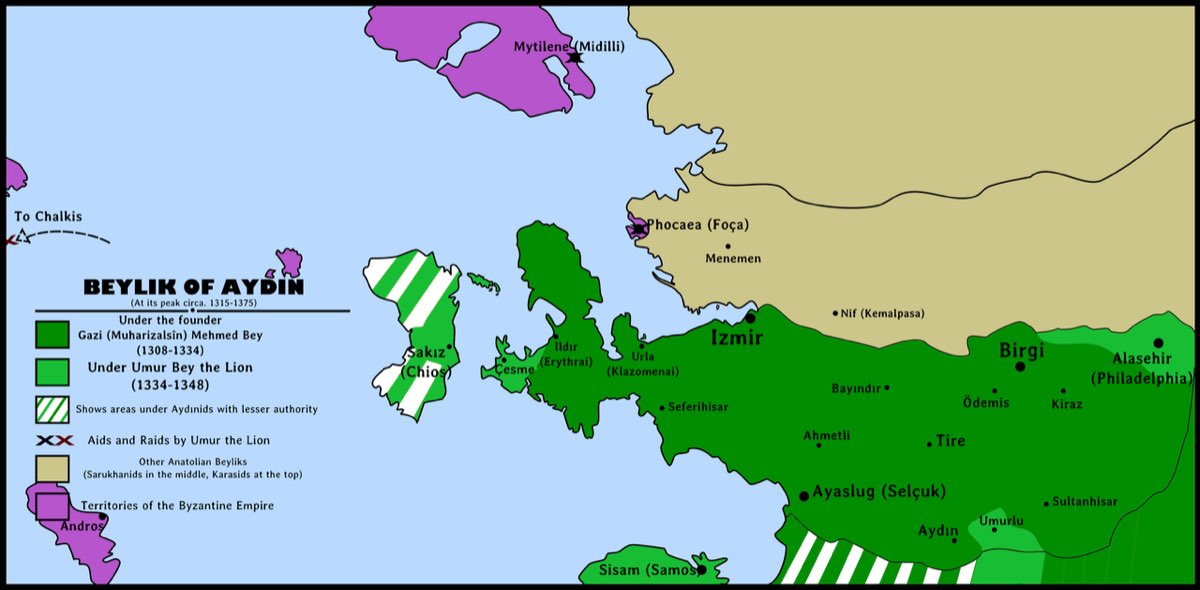
Principality
Aydinogullari principality was one of the conqueror Turkmen principalities that opened the ways to the Western Anatolia and Aegian coastal regions. One of the great characters of the history of Turkey who was named as Gazi Umur Bey had been contemporary with this principality. They had dominated firstly 90 years between 1300 and April 1390 and then 23 years between the dates of 28th July 1402 and 1425. The total period of their domination was equal to 116 years.
They had been annexed to the Ottoman State in the period of Yıldırım Bayezid for 12 years and 3 months between the dates of April 1390 and 28th July 1402. They had been submissive to Seljuk State until the year of 1308 and then to Ilhanli State until the year of 1335. Then, they had become independent. Between the years of 1308-1312, they had been submissive to Germiyanogullari principality that had been subject to the domination of Ilhanli State. In fact, the Aydin beys had been in the service of Germiyanogullari principality in the beginning of their period. They had become submissive to the Ottomans again in 1403. In the following 22 years, they were sometimes annexed to Ottoman State in general or they rebelled against them. This period is represented by Cuneyd Bey.
As it is known, Aydinogullari Principality was founded by Aydin Bey as a forefront principality of Seljuk State. They had been submissive to Ilhanli State between the years of 1308 and 1335, then they had become independent and sometimes they had been under the domination of Ottoman State. They dominated in Aydin, in some basins of Izmir, Alaşehir, Salihli and within its environs. The most famous ruler of this principality was Ghazi Umur Bey. He had dominated in the Sea of Islands (Aegean Sea) with a powerful navy. This principality was annexed to the lands of Ottoman State in the year of 1425. The most significant port town of this principality was Ayaslug (Ephesus). They organised raids to the surrounding regions with a navy arranged in this town. As a matter of fact, Mehmed Beys son, Umur Bey had organised successful raids towards Chios, Bozcaada, Semadirek island, the environs of Gümülcine, Aegean Islands and the coastal regions of Mora and had captured the coastal regions of Izmir (1328). These successful activities lay the foundation for his enthronement as the sovereign of the principality pursuant to his fathers death (1334).
Umur Bey had organised expeditions to Greece and Mora together with Saruhanoğlu Süleymân Bey and they had returned to Izmir with numerous captives and spoils (1335). Umur Bey had established friendly relations with the Byzantine and had joined in their military expeditions. Therefore, he had advanced to the Black Sea and despoiled the countries of Kili and Eflak (1339-40).
Furthermore, he had intervened in the struggles for the throne in the Byzantine. Upon the activities of the navy of Aydinogullari principality in the Aegean Sea, the chevaliers of Rhodes concluded an agreement with Umur Bey on condition that they would give Izmir and their trade would not be hindered. But this agreement was not approved by the Pope. Ghazi Umur Bey tried to capture Izmir for this reason, but he died in battlefield as a martyr (1348).
His period of reign was a glorious period in which important developments had been observed in every field in the Aydinogullari principality. Umur Beys brother, Hizir Bey was not an active and brave ruler like his elder brother. Therefore, he had to sign an agreement with Latins under heavy conditions. Afterwards, the activities of Aydinogullari principality had stopped and the principality was on the verge of decline. In Kosovo War (1389), the forces of Aydinogullari principality had been involved among the reserve forces within the Ottoman army. When Sultan Murad I was taken as prisoner in this war, Yıldırım Bayezid had become sultan, and a movement was organised against him among the Anatolian principalities upon the encouragement of Karamanogullari principality. Aydinogullari principality was involved in this movement. Aydinogullari principality became submissive to the Ottoman State in the course of the military expedition to Anatolia organised by Yıldırım Bayezid in order to subdue the principalities (1390).