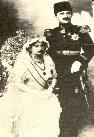
However, this radical change in the thought formation of Enver Pasha took place after Baku Eastern Peoples Congress. Enver Pasha, analyzed the power equilibrium in the world in Baku congress, the status of Ottoman Empire between these powers, and the alliance of Ottomans and Germans with the political attitude of İttihat ve Terakki during the congress, and after it, he stressed that Soviets developed three objectives. The first one of these objectives was to support the autonomous character of anti-English movement in Muslim and eastern countries, second, forced exportation of the revolution to Muslim and Eastern countries and cooperation with the democratic groups, and the third refusal of any government model in Islam world excluding Muslims.
Enver Pasha, determining the structure of Soviet Revolution and the peoples being exploited in the world politics, specifies his determination in Baku General Assembly as follows: My friends... I would like to express my gratitude to Third International and its determined chiefs who are the deputies of revolutionary East warring against world imperialism and capitalism in Baku city and who contributed to our gathering here on behalf of the public and friends. Today we should congratulate each other because we established an alliance with an ally as Third International, which is going to help us in our struggle against world imperialists and capitalists not only killing us, but also stealing all of our properties, which is honest and trustworthy inversely proportional with the lies of European politicians and which has written recognition of laws and freedoms of nations down in its program...
Now, the side of Enver Pasha, who also stated that the real war was against Western imperialist powers as from Trablus and Dardanelles defense together with all persecuted peoples of Soviets and East, was Turan Communitarian. Anyone pursuing Enver Pasha, with regard to his Russian life excluding his political and military activities, observes that he developed Turan Communitarian idea dependant on Third International in nearly all ideological and intellectual backgrounds where Enver Pasha expressed himself. The assessment by Enver Pasha in Baku General Assembly on world politics and the position of İttihat ve Terakki and Eastern peoples in this political order in particular is an extraordinary turning point with regard to what Communitarian is, what nationalism is and should be in the future in his future political activities.
Enver Pasha disclosed that Revolutionary Organization Alliances of Algeria, Tunisia, Trablusgarp, Egypt, Arabia and India, which authorized him to represent themselves in the congress, held the same opinions in this new stage of the struggle, by virtue of his being the highest military authority of the country and by providing restructuring of Islam-Eastern world on this path by means of the relations he had established. Enver Pasha deemed this analysis as the opening of the liberation path of persecuted nations and a way to victory for the persecuted of the world.
However, pursuant to young Soviet States depending on a regime based on Russian domination, Enver Pasha separated the roads with Moscow, and formed a new strategy called Turkish-Islam Federal State.
He depicted his thought in a letter he wrote to Afghanistan King Emanullah Khan in 1922 as follows: The confederation of Eastern Islam governments shall be realized under our supervision ending the Russian rule. We thank very much for the assistance of your majesty. Within this context, this state which shall stand alone and resemble German federation in the world, will emerge in a short period of time.
The real objective behind this was to form the core of the new Turk-Turan Empire extending from the borders of a Turkey powerful as it was in the past to Indian borders.
Enver Pasha, wanted to play an important role in such a Pan-Islamist and Pan-Turkist state involving Muslims in East Turkistan and even Afghanistan. Thus, he was going to be able to unite under the red flag the Turks living in the huge territories of Turkistan and to defy both newly born Soviet Union and English Imperialism under his leadership.
Enver Pasha, for realization of this project, established an organization named Mesai Peoples Party to construct the political background of the project as from the period he formed an alliance with Soviet state. Mesai, the program of which was radical to the utmost, was unusual for the day. This program comprising of Socialist unionist, Islam and nationalism ideas was interpreted by Enver Pasha in afterwards that Mesais spirit was socialism. As to Zurcher, Mesai, although it was not a Orthodox-Marxist program, took most of its terminology from Marxism.
Nevertheless, a more interesting aspect of this program is that Enver Pasha had initiated the first serious efforts to form a theoretical background for Communitarian Nationalism. Enver Pasha stresses two issues in particular in the manifest in question. The first was that Mesai made clear that pro-İttihat people maintained Bolsheviks, and the second was that it constituted a theoretical base for pro-İttihat activities against Mustafa Kemal in National Parliament in Ankara.
Therefore, Enver Pasha was constantly distributing his draft political plans in order to make people remember that he is more leftist and innovative than Mustafa Kemal government. As a matter of fact, Enver Pasha, in a letter he wrote to Mustafa Kemal, said that he was sure of the advantages of communism for Anatolian Turkey and that communism would be applicable with regard to socio-economic conditions for Turkey.
The manifest issued after People Council Party which he attended on behalf of Turkey between 5 and 8 September 1921 also confirmed the revolutionist theory of Young Turks and Communist International as well as the role of İttihat Terakki committee as a pioneer. The program consisting of 12 chapters and 58 articles, besides its Islamist and nationalist inclinations, suggested establishment of Turkey with Soviet Revolution as the only way to save Turkey from imperialists sharing.
Enver Pasha dealt with nationalism with its socio-economic aspect for the first time besides its political aspect. The fact that theoretical background bore the same lines with socialist revolution and Marxist character, saved it from both the unidimensionalism of western nationalists and from an insistive intellectual structure.
For him, the essence of war was capitalism and the monopolists, usurers, and people earning without working, produced by capitalism; represented worldwide by western imperialism taking the offensive against all eastern countries. Western imperialism, invented many pretexts to provoke conflicts between peoples of East to exploit.