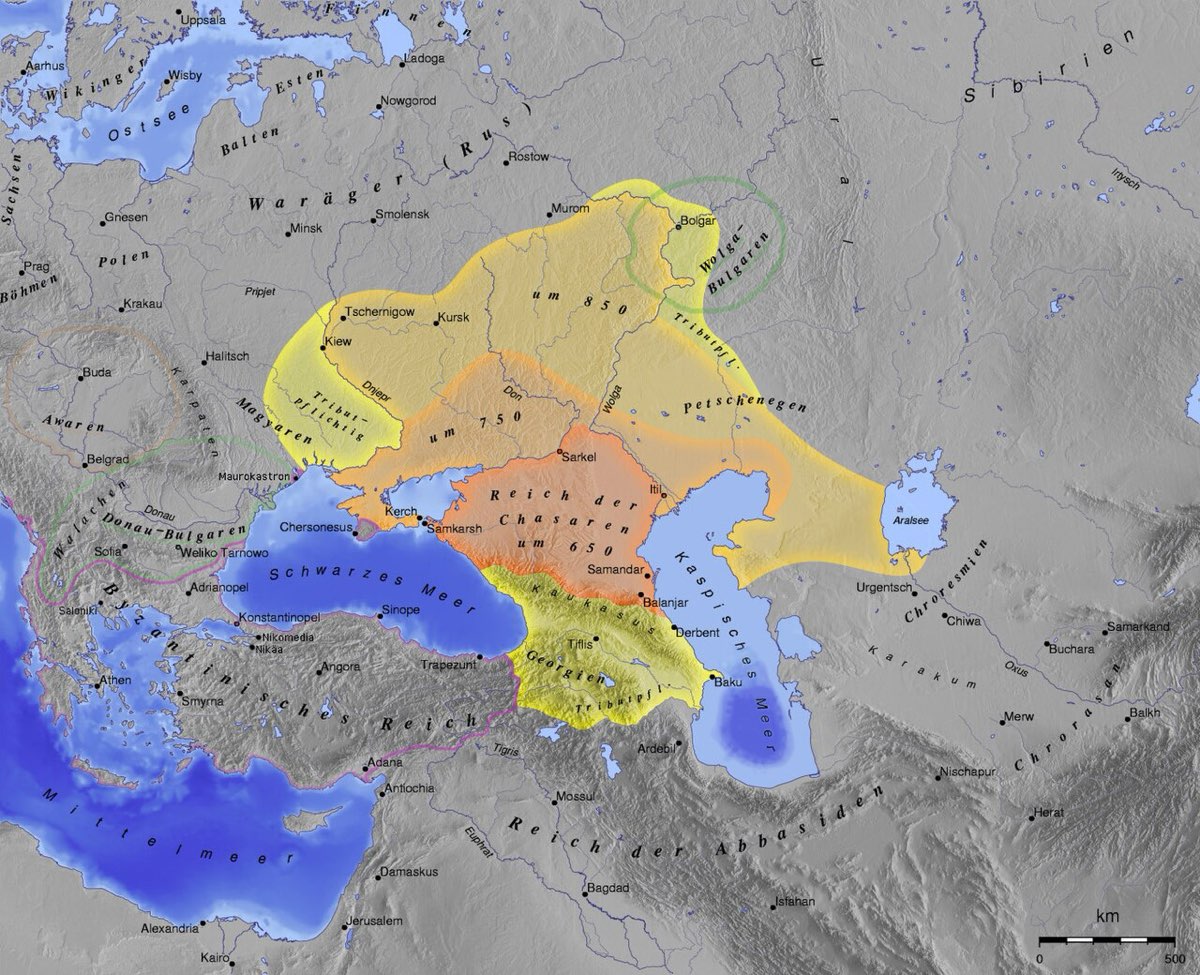
This strong resistance, which had been shown against the Arabic army in the most powerful periods of the Islamic caliphate empire again brought the strength of the Hazarian state to front. Indeed, the khanate between the 8th-9th century, as it can be seen in the expressions of the Islamic writers, had been in the same rank as China and Byzantium and was supposed to be the biggest political formation in East Europe. It's borders had expanded especially on west and north sides, and following countries had been taken under the domination of the khanate: "Avarlar" the land of the "Serir" in north Caucasia, the Alan's, the On-ogurs and the mountain tribes of Caucasia, the Got's in Crimea, the Bulgarian Itil's, the Fin-Ugor Burtas around the Volga and other various Fin arms, the Radimich from the slavic groups of the region around river Desna and middle Dnyeper, the Vyatich, the Severian, the Polian etc., the Hungarian from the environs of Kuban, Kiev and it's surroundings.
So, according to an inscription (Eldad ha-Dani) from the 9th century, one of the main possibilities that provided the political power for the Hazar's, of whom it is said that their khane was on top of "25 kings", had been the fact that the khanate, according to it's geographical position, was in the centre of the - probably for the Middle Ages - most active trade region. Many items were brought to the Hazarian country, especially fur (sable, pine marten, fox etc.) and other trading goods (beeswax, glue) from Scandinavia, Volga and the sides of Kama, silk and fabrics from China and Turkmenistan, various art and decoration items from Byzantium, which were sold in Itil and other Hazar cities.
This various and rich goods passed hands between the continents of Middle Asia-East Europe-Near East. The Hazar khanate had become an elite political formation among the Turkish States from the aspect of supplying high incomes to the state, by organising and making the most profitable use of this commercial activities and putting them under security and control.