Economy
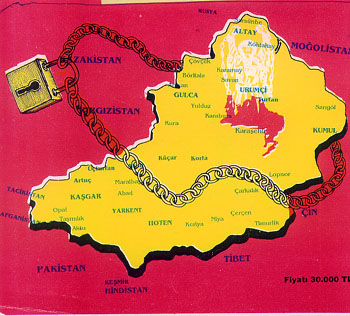
The Eastern Turkistan is a country that have some strategic raw materials such as petroleum, wolfram, gold, coal, uranium, etc. and numerous rich resources over and under the ground. 118 types of 148 minerals in China are extracted from the Eastern Turkistan. 5000 mine pits have been commissioned in the Eastern Turkistan so far; and these mine pits constitute 85% of the total mines and pits in China. "Petroleum" is extracted from approximately 500 regions and "natural gas" is extracted from 30 regions. Its petrol reserves were determined as 8 billion tonnes. 10 million tonnes of petroleum are transported to China in every year. Half of the coal reserves of China are in the Eastern Turkistan. The annual "gold" production is about 360 kg. The principal underground products of the Eastern Turkistan are the strategic minerals such as uranium, wolfram, etc. and salt and the coloured crystal stones. The Eastern Turkistan has a farming area of 150 thousands km2 with the same area as arable fields and a forest area with the width of 12 bin km2. In its plateaus, nearly 60 millions of sheep, goats, and cattle are bred. 90% of those who work in industrial facilities and 99% of those who work in the petroleum plants are composed of the Chinese people who are brought to the region for settlement.
Cultural Structure
50% of the people in Sincan Uighur Autonomous Region speak the Uighur Turkish language. The Arabian script that they used for 1000 years was totally prohibited by the government of China on the date of 23.10.1969. Instead of this alphabet, the Latin alphabet was adopted that was arranged properly in accordance with the Chinese phonetics. Peking rejected the project of Cyrillic alphabet suitable for the Uighur phonetics that was prepared by the Uighur intellectuals in 1980s. Due to the fact that the majority of the people were of Turkish roots, the language of Turkish is spoken in the Eastern Turkistan despite all the factors. The Eastern Turkistan that was an ancient Turkish homeland was one of the lands on which Turks started to settle down. Uighur architecture is very famous all over the world and it contains the Turkish-Islam architectural characteristics. The New Uighur literary period (Uighur literature in the century XIX) includes the period in which lots of works of art were written about the struggles against the Chinese invasion troops, Chinese domination and the wars against them in the Eastern Turkistan. The literary works created have constituted the base for the new national literature that was formed by the Uighur Turks.
Education-Training
The rate of the illiterate persons in the Eastern Turkistan is about 68-60%. Only 16% of the publications are written in Uighur Turkish. The information about the history, culture and ethnical history of the Eastern Turkistan region was prohibited from being reflected in different manner than the official interpretation style. It was also prohibited that the educational institutions could not have direct relations with the other educational institutions in the foreign countries. Those that violate these prohibitions were imposed with the heaviest penalties. Due to the change of the alphabets in every year, the education of the children has been hindered and their training has been obstructed.
The End
Back to Menu